

Agentic AI Architecture for Enterprise Scale: Design Before You Build
Most organizations building agentic systems treat architecture as an afterthought. They focus on prompt engineering, model selection, and capability. They build the agent, test it, and only then ask: "Now how do we integrate and align this into our enterprise architecture?"
This is backwards.
Enterprise-grade agentic systems require architectural decisions made upfront, not retrofitted later. The difference between a working pilot agent and a production-grade autonomous system running across your enterprise is architecture.
Research on enterprise AI adoption shows that this matters. Gartner's analysis of enterprise AI implementations finds that approximately 80% of AI pilots fail to scale—typically not due to technology limitations, but due to operationalization and governance gaps. McKinsey's research on enterprise AI governance demonstrates that organizations with explicit governance frameworks built into system design show 40% higher implementation success rates. This is architecture working as intended.
This article walks you through what enterprise agentic architecture actually means and how to design systems that scale reliably, stay governed, and deliver measurable business outcomes.
The Gap: Pilot Agent vs. Enterprise Agent
Let me illustrate with something I see across every customer engagement.
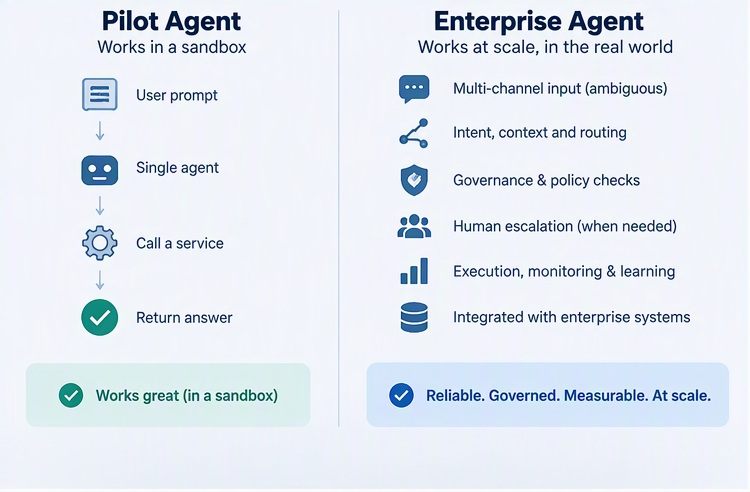
A pilot agent works like this:
- Team builds an agent to solve one problem
- Agent calls a service, gets a response, returns an answer
- Works great in a sandbox environment with test data
- Team declares victory
An enterprise agent must work like this:
- Agent receives ambiguous input from multiple channels
- Agent must interpret intent, handle missing information, route appropriately
- Agent executes with governance controls and audit trails
- Agent escalates to humans when confidence is low or risk is high
- Agent is monitored for drift and quality degradation
- Agent's decisions are measurable and traceable
- Agent integrates with existing processes and case management
- Agent scales to thousands of instances across business units
- Agent remains predictable and controlled as scale increases
The difference isn't the technology. It's the architecture.
Most organizations move from scenario 1 to scenario 2 by adding requirements one at a time. Each requirement is bolted on: "Oh, we need to add a harness." "Oh, we need to add more human oversight." "Oh, we need to address some of the points from Enterprise Architecture and the AI Governance Board."
This creates fragile, complex systems that break under scale.
Enterprise organizations need to start with scenario 2. They design for governance, oversight, measurement, and scale from day one. Everything else flows from that foundation.
What Enterprise Agentic Architecture Means
Enterprise agentic architecture is the structure that enables predictable autonomous decision-making at scale.
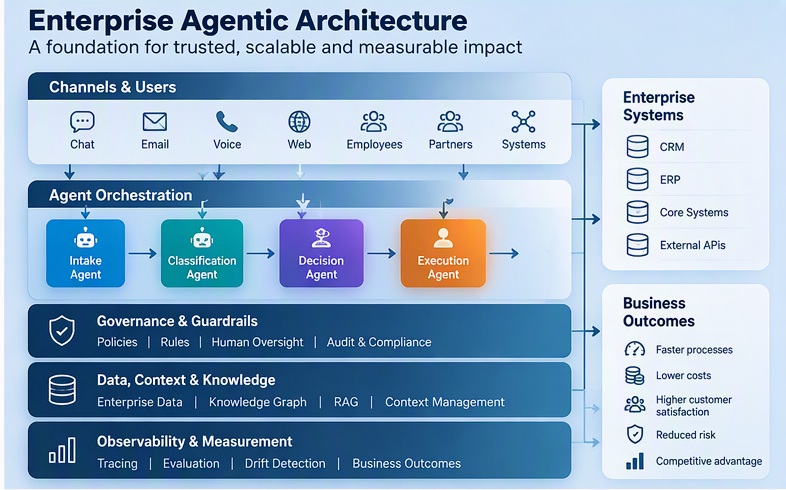
It answers:
Strategic Questions:
- Which business processes are candidates for agentic automation?
- What level of autonomy is appropriate for each decision?
- How do governance and oversight integrate with agent execution?
Structural Questions:
- How should agents be orchestrated (single agent vs. multi-agent)?
- How do agents interact with existing systems and processes?
- Where do humans intervene in the agent's decision flow?
- How is data (context, decisions, outcomes) managed and traced?
Governance Questions:
- How do compliance requirements shape agent behavior?
- How are decisions audited and explained?
- How does the system detect and respond to drift or failure?
Measurement Questions:
- How do you measure agent reliability before production?
- How do you measure business impact after deployment?
- How do you ensure agents improve processes, not just automate them?
Architecture is what connects all these questions into a coherent system.
Five Architectural Principles for Enterprise Agentic Systems
Based on what I've observed across various customer engagements, discussions with practitioners, industry peers, and in articles, publications and research, here are the principles that separate enterprise-grade systems from pilots that fail to scale.
1. Governance-First Design
Don't build agents first, then add governance. Design governance into the architecture from day one.
The EU AI Act (2024) requires high-risk autonomous systems to maintain human oversight and audit trails. The NIST AI Risk Management Framework emphasizes that governance must map directly to engineering controls. This isn't regulation-as-burden, it's a description of what enterprise systems must look like. Architecture is how you make it operational.
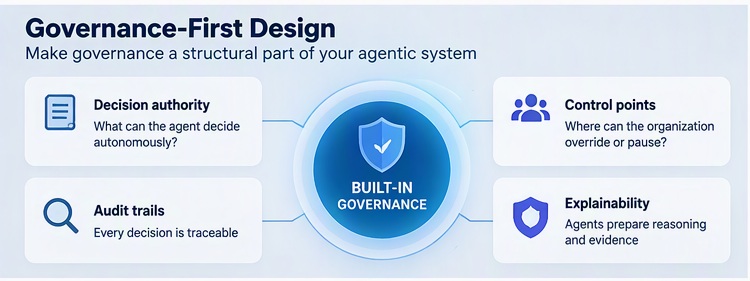
This means:
- Decision authority is architecturally clear: What can the agent decide autonomously? What requires escalation?
- Control points are built in: Where can the organization override or pause agent decisions?
- Audit trails are structural: Not added as an afterthought, but baked into every decision path.
- Explainability is designed in: Agents don't just decide—they prepare explanations and evidence.
In practice: The agent architecture includes a declarative rules layer that governs what the agent can decide. The agent proposes structured decisions. The rules deterministically approve or escalate the proposals. This is architecture. It's not bolted on; it's foundational.
2. Process-Aware Design
Don't architect agents in isolation. Design them to fit into and improve existing business processes.
Process mining research (van der Aalst, 2020) demonstrates that understanding current workflows - not just automating tasks - is foundational for intelligent automation success. Enterprise systems that ignore process intelligence and context (including the traces, it's distributions, related objects aso) inevitably fail because they optimize for agent capability rather than measurable business outcome.
This means:
- Understand the process first: What are the current pain points in a process?
- Design agent responsibilities clearly: What part of the process should the agent own? What stays with humans?
- Integrate with case management: Don't create separate agent workflows. Integrate with existing case/workflow management systems.
- Measure process impact: Success isn't "agent works." It's "process measurably improves."
In practice: We often see teams automating individual steps without understanding the broader process and it's challenges holistically. They automate a small part (e.g. intake classification) brilliantly, but downstream routing is manual or the biggest effort or cost driver isn't addressed. Process-aware architecture means designing the agent's work as part of an end-to-end process flow.
3. Human-Centered Escalation
Don't design humans out. Design humans in strategically.
Research on human-AI collaboration (Amershi et al., 2019) demonstrates that human oversight is most effective when AI systems provide clear reasoning, confidence scores, and supporting evidence. This isn't a feature, it's an architectural requirement and a usability and experience topic. When you design escalation strategically, humans become more effective, not less.
This means:
- Escalation is architectural: When humans should intervene is a design decision, not an afterthought.
- Context is prepared: When you escalate to humans, you prepare context, evidence, and recommendations.
- Authority is clear: Who decides what at each escalation level?
- Feedback loops exist: How do human decisions teach the agent?
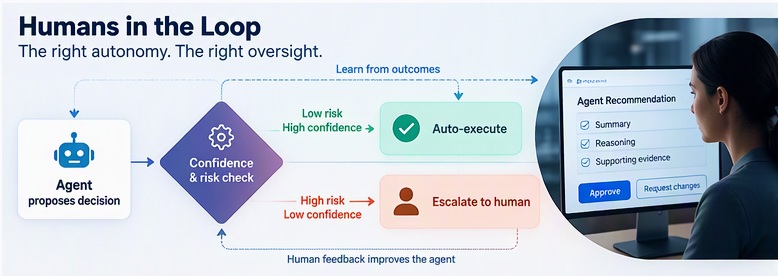
In practice: The best multi-agent systems don't maximize agent autonomy. They optimize for "appropriate autonomy", autonomy matched to risk, confidence, and reversibility. If a decision is reversible and low-risk, the agent decides. If it's irreversible or high-stakes, humans decide with agent recommendations.
4. Observable Design
Design systems you can see into. Observability is architectural.
This means:
- Every decision is traceable: What did the agent do? Why? With what confidence?
- Behavior is monitorable: What patterns are emerging? Is the agent drifting?
- Quality is measurable: Before production (golden dataset testing), during production (silent testing), and ongoing (runtime monitoring).
- Failures are visible: Not hidden in logs, but surfaced systematically.
In practice: When confidence drops below a threshold or patterns shift, teams should be alerted. That's not a feature bolted on to the agent. That's architectural from day one.
5. Multi-Agent Coordination
Design for complexity. A single agent is rarely the answer.
This means:
- Agent responsibilities are scoped: Each agent has a clear job. Not a monolithic "do everything" agent.
- Orchestration is explicit: How do agents hand off to each other? How do they share context?
- Conflict resolution is designed in: When agents have competing goals, how is conflict resolved?
- Learning is systemic: How do insights from one agent improve others?
In practice: At Pega, the MCP (Multi-Channel Orchestration) framework enables this kind of architecture. You have specialized agents for intake, classification, routing, execution. They coordinate through explicit interfaces, not implicit dependencies.
Two Reference Architecture Patterns
Let me ground this in specific patterns that work at enterprise scale.
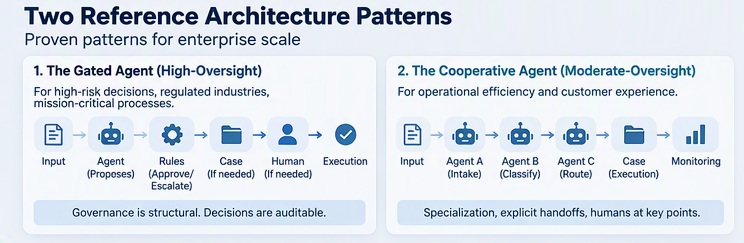
Pattern 1: The Gated Agent (High-Oversight)
When to use: High-risk decisions, regulated industries, mission-critical processes.
Architecture:
Input → Agent (Proposes) → Rules (Approve/Escalate) →
Case (If escalation) → Human (If needed) → Execution →
Monitoring (Outcomes & Drift)
How it works:
- Agent proposes a decision with reasoning and confidence
- Declarative rules evaluate the proposal (does it pass governance checks?)
- If approved by rules, agent executes
- If not approved, escalates to case management for human review
- All decisions logged and monitored
Why it works: Governance is structural. Humans never lose visibility. Decisions are auditable.
Pattern 2: The Cooperative Agent (Moderate-Oversight)
When to use: Moderate-risk decisions, operational efficiency, customer experience.
Architecture:
Input → Agent A (Intake) → Agent B (Classify) → Agent C (Route) →
Case (Execution) → Monitoring
How it works:
- Multiple specialized agents handle different parts of the process
- Agents coordinate through explicit handoffs
- Humans monitor the workflow and intervene when needed
- System learns from human interventions (e.g. annotations and silent evaluation)
Why it works: Specialization reduces complexity. Handoffs are explicit. Humans are positioned at key decision points.
How Architecture Enables Governance
This is the critical point: Architecture is how governance becomes operational.
Too many enterprises separate these concerns. They build agents over here. They build governance structures over there. Then they try to bolt them together.
Enterprise architecture makes governance a structural property of the agent system, not a layer on top of it.
Here's what that means in practice:
Decision Authority (Architectural)
Agent can decide if:
  • Confidence > 90% AND
  • Decision is reversible AND
  • Customer risk score < threshold
Otherwise:
  • Escalate to human
This isn't a policy. It's architecture. It's built into the agent's execution flow.
Audit Trail (Architectural)
Every decision captures:
  • What the agent decided
  • Why (reasoning)
  • Confidence level
  • Supporting evidence
  • Who approved (if escalated)
  • Outcome (what happened next)
This isn't added later. It's structural from day one.
Measurement (Architectural)
System continuously measures:
  • Agent reliability (accuracy on golden dataset)
  • Process impact (cycle time, cost, quality improvements)
  • Business outcomes (revenue, satisfaction, risk)
  • Drift (does agent behavior change over time?)
This isn't reporting. It's built into how the system operates.
When governance is architectural, it's efficient, auditable, and effective. When it's bolted on, it's friction, complex, and fragile.
The Measurement Question: How Do You Know It Works?
Enterprise architecture must support measurement at three levels:
Level 1: Agent Reliability (Does the agent work?)
- Golden reference testing (pre-deployment)
- Silent testing (early production)
- Runtime monitoring (ongoing)
Level 2: Process Impact (Does the process improve?)
- Cycle time (faster?)
- Cost (cheaper?)
- Quality (better?)
- Customer experience (more satisfied?)
Level 3: Business Outcomes (Does the enterprise win?)
- Revenue impact
- Risk reduction
- Compliance improvement
- Competitive advantage
Most organizations obsess over Level 1 and ignore Levels 2 and 3. Enterprise architecture must support all three.
Practical Steps: Design Your Agentic Architecture
If you're building agentic systems in your enterprise, here's how to approach it:
1. Start with Process Intelligence Before you design the agent, understand your current process. Where are the inefficiencies? Where do decisions happen? Where do humans add value vs. friction? Process and Task Mining and Analytics are very helpful here to build a data backed view!
2. Define Decision Authority What decisions can be autonomous? What requires human judgment? What's the criteria for each?
3. Design for Governance First What governance structures must exist? Build them into the architecture, not on top of it.
4. Choose Your Reference Pattern Gated (high-oversight) or Cooperative (moderate)? Most enterprises start with one of these two patterns.
5. Build for Observability Design systems you can see into. Every decision should be traceable and measurable.
6. Plan for Multi-Agent Coordination Most enterprises need multiple agents. Design the orchestration and handoff patterns upfront.
7. Define Measurement (All Three Levels) How will you measure agent reliability, process impact, and business outcomes?
The Enterprise Reality
Building agentic systems is not primarily a technology problem. Your models work. Your frameworks work. Your infrastructure works.
The problem is architecture. Most organizations are trying to retrofit enterprise requirements onto systems designed for pilots.
The organizations that will scale agentic AI predictably are those that design for enterprise from day one. They start with governance. They design for oversight. They architect for measurement. They plan for scale.
Architecture is how you make that happen.
RESEARCH FOUNDATION
This article is grounded in regulatory requirements, academic research, and industry practice. Here's the research backing enterprise agentic architecture:
Regulatory Frameworks
The EU AI Act (2024) requires high-risk autonomous systems to maintain human oversight and audit trails. The NIST AI Risk Management Framework explicitly calls for governance to map to engineering controls. ISO/IEC 42001 requires organizations to establish AI governance systems. These aren't optional guidelines—they're regulatory requirements that enterprise agentic architecture must satisfy.
Academic Research
Research on human-AI collaboration (Amershi et al., "Guidelines for Human-AI Interaction," Microsoft Research, 2019) demonstrates that oversight is most effective when systems provide clear reasoning and confidence. Process mining research (van der Aalst, "Process Mining: Data Science in Action," 2020) establishes that understanding workflows is foundational for intelligent automation. Multi-agent systems research (Weiss, "Multiagent Systems," 2013) confirms that agent coordination requires explicit architectural design.
Industry Research
Gartner's analysis shows that approximately 80% of AI pilots fail to scale—typically due to operationalization gaps, not technology limitations. McKinsey research on enterprise AI governance demonstrates that organizations with explicit governance frameworks built into system design show 40% higher implementation success rates. This validates that architecture, not post-deployment governance, drives success.
Standards & Frameworks
IEEE standards for autonomous systems governance (IEEE 7000-7004) align with these principles. Enterprise architecture frameworks like TOGAF establish that architecture must drive governance and operational effectiveness. BPMN process modeling standards inform how we design agents within business processes.
Key Takeaways
- Architecture comes first—before building agents, design the system that governs, oversees, and measures them.
- Governance is structural—not a policy layer on top, but part of how the agent system works.
- Humans stay in control—through architectural escalation, not bolted-on oversight.
- Process context matters—design agents into existing processes, not in isolation.
- Measurement is multi-level—agent reliability, process impact, and business outcomes.
- Multi-agent systems are normal—design orchestration patterns upfront.
- Observability is non-negotiable—build systems you can see into and trace through.
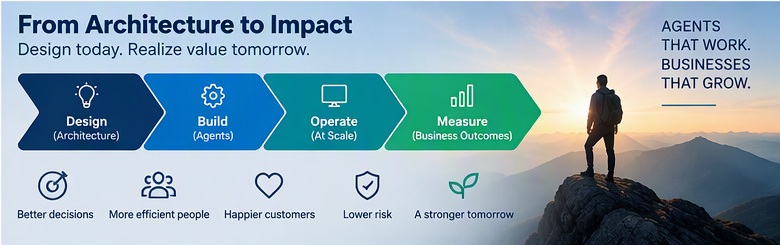
The difference between a working agent and a working agentic enterprise is architecture.
Design it right from the start.
FURTHER READING
Regulatory & Governance:
- EU AI Act (2024): https://artificialintelligenceact.eu/
- NIST AI Risk Management Framework (2023): https://nvlpubs.nist.gov/nistpubs/ai/NIST.AI.RMF.1.0.pdf
- ISO/IEC 42001:2023 - Information technology — Artificial intelligence — Management system
Academic Research:
- Amershi, S., et al. (2019). "Guidelines for Human-AI Interaction." Microsoft Research.
- van der Aalst, W.M.P. (2020). "Process Mining: Data Science in Action." Springer.
- Weiss, G. (Ed.). (2013). "Multiagent Systems: A Modern Approach to Distributed Artificial Intelligence." MIT Press.
Industry Research:
- Gartner AI Adoption and Enterprise AI Reports (2023-2024)
- McKinsey: "The State of AI in 2023" and "AI Governance" reports
- Forrester: Enterprise AI Maturity Models
Standards & Frameworks:
- IEEE 7000-7004: Standards for AI Governance
- The Open Group Architecture Framework (TOGAF 9)
- ISO/IEC/IEEE 42010: Systems and Software Architecture
- OMG Business Process Model & Notation (BPMN)
AI Use / Disclosure: This work represents my own ideas, objectives, expertise, and professional judgment. The underlying ideas, analysis, and final conclusions were developed and validated by me. Generative AI tools were solely used as an editorial aid to to assist with language refinement, formatting, style, structural improvements and image generation.