

From AI Governance to AI Value Assurance: Why Enterprises Need to Govern Value, Not Just Risk
A governance framework answers one question perfectly (Can we trust it?) but leaves another equally important one unanswered (Is it creating measurable value?).
Governance without value assurance is expensive risk management.
The Governance Trap
An organization builds an AI governance framework. It includes:
- ✅ AI policies and principles
- ✅ Risk classification matrix
- ✅ Approval workflows
- ✅ Human oversight requirements
- ✅ Audit and monitoring controls
- ✅ EU AI Act compliance procedures
But here's what nobody's measuring:
- ❓Did the process actually improve?
- ❓Is cycle time faster?
- ❓Is cost lower?
- ❓Is customer satisfaction higher?
- ❓Did we actually create the value we said we would?
The governance framework answers "Is this system trustworthy?" perfectly. It doesn't answer "Is this investment paying off?"
These are different questions. And they require different controls.
The Board's Two Questions when approving AI
When your board evaluates an AI investment, they're actually asking two questions:
Question 1: Can we trust it?
- Will it fail safely?
- Is it under control?
- Can we explain its decisions?
- Are we compliant?
- Do we understand the risks?
Question 2: Is it creating value?
- Is the business outcome materializing?
- Can we measure it?
- Is the ROI positive?
- Are we competitive?
- Should we scale this?
Your governance framework answers Question 1 brilliantly.
Most organizations don't have a coherent answer to Question 2.
Why This Matters Now
Three things have converged:
First: Governance is maturing. Organizations are building AI governance frameworks. Policies are in place. Compliance is being met. The "Can we trust it?" question is increasingly well-answered.
Second: Scale is accelerating. Organizations are moving from "we have a few AI systems" to "we're building 50+ AI systems." At that scale, you can't measure value one system at a time. You need a portfolio approach.
Third: The market is shifting. Enterprises that can prove AI value will get investment. Enterprises that can't won't. This is especially true as CFOs become more skeptical and boards demand ROI. The competitive advantage goes to organizations that can credibly answer "Yes, it's creating measurable value—and here's the proof."
Enter: AI Value Assurance.
What Is AI Value Assurance?
AI Value Assurance is the discipline of proving business value while managing risk, at scale, across an enterprise AI portfolio.
It's different from governance. Governance manages risk and control. Value assurance proves value and measures impact. Together, they answer both board questions.
Here's what Value Assurance requires:
- Clear intent about what value you're trying to create
- Evidence that the system can create that value before you make it autonomous
- Operational controls that keep it reliable at scale
- Measurement that proves the value is real
This isn't bolt-on. It's structural. It changes how you design, deploy, and govern AI systems.
The Four-Level AI Value Assurance Model
I propose organizing AI Value Assurance into four levels. Each level answers a specific question and requires specific evidence.
Level 1: Value Intent
The question: What business outcome are we actually trying to achieve? What's the baseline?
This is where most organizations fail. They start with "Let's automate this process" without asking "Will automating this actually create the value we think?"
Value Intent requires:
- Clear definition of the business outcome (cycle time reduction? Cost savings? Risk reduction?)
- Baseline measurement of the current state
- Target definition of the desired future state
- Success criteria for the AI system
In practice: A financial services organization wanted to automate loan approval. The real business outcome wasn't "faster approval"—it was "higher approval rate without higher loss ratio." That's a different optimization target. Value Intent made that explicit from day one.
Governance connection: Your policies should require explicit Value Intent before approval. If you can't articulate what business outcome you're optimizing for, the system shouldn't be approved.
Level 2: Evidence Before Autonomy
The question: Can we trust this system to deliver that value?
This is where evaluation happens. You gather evidence that the system can actually do what you're asking it to do—before you give it autonomy.
Evidence Before Autonomy requires:
- Golden reference testing on representative data
- Silent testing in parallel with human decisions
- Business outcome testing (not just accuracy—does it improve the business process?)
- Human review before autonomous decisions
In practice: Before a healthcare organization let an agent triage patients autonomously, they ran silent testing for two weeks. The agent made triage recommendations while humans made the actual decisions. That evidence proved the agent was reliable enough for autonomy.
Governance connection: This is where your human oversight, escalation, and quality controls live. You're building evidence, not just managing risk.
Level 3: Operational Assurance
The question: Can we keep it working at scale?
This is where predictability comes in. Once the system is live and autonomous, you need controls that ensure it stays reliable, predictable, and under control.
Operational Assurance requires:
- Governance structures that define decision authority
- Escalation procedures for edge cases and low-confidence decisions
- Monitoring for drift, degradation, and anomalies
- Controls that can pause or redirect the system if needed
In practice: A manufacturing organization deployed an agent for preventive maintenance scheduling. Operational Assurance meant:
- The agent could schedule routine maintenance autonomously
- Edge cases (equipment failures, schedule conflicts) escalated to humans
- Daily monitoring tracked decision patterns and cost impact
- If costs spiked, the system could be paused while engineers investigated
Governance connection: This is where your control tower lives—the centralized dashboard that lets you govern multiple AI systems simultaneously.
Level 4: Value Realization
The question: Is it actually creating the value we defined in Level 1?
This is the critical question that most organizations leave unanswered. You measure accuracy, precision, recall—all technical metrics. But did the business outcome improve?
Value Realization requires:
- Measurement of the business outcome (cycle time, cost, quality, revenue, customer satisfaction)
- Comparison to baseline (did it improve relative to Level 1 baseline?)
- Attribution (did this AI system cause the improvement, or was it other factors?)
- ROI calculation (is the value greater than the cost?)
In practice: A customer service organization deployed an agent to handle routine inquiries. They measured:
- Technical metrics: Accuracy 92%, confidence calibration good
- Process metrics: Cycle time reduced 30%, escalation rate 8%
- Business metrics: Customer satisfaction increased 12%, cost per interaction down 40%
- ROI: System cost $200K/year, value delivered $1.2M/year
The technical metrics looked good. The business metrics proved it was worth the investment.
Governance connection: This is where your board gets their answer. Not "Is it working?" but "Is it creating value?"
How the Four Levels Connect
Here's the critical insight: you need all four levels, and they must be connected.
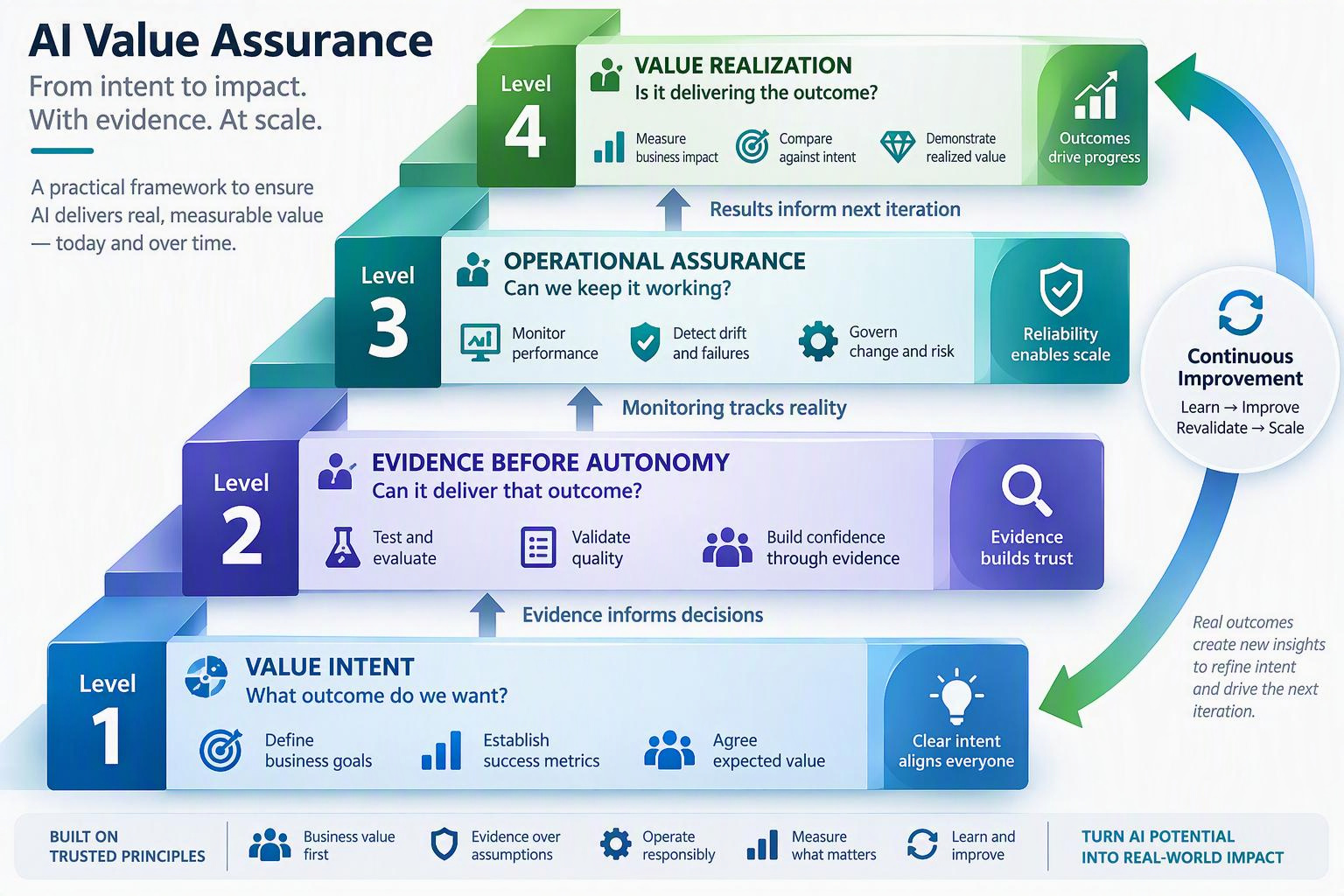
Skip any level, and the model breaks:
- Skip Level 1 → You don't know what success looks like
- Skip Level 2 → You deploy untested systems
- Skip Level 3 → Systems degrade silently
- Skip Level 4 → You never know if it actually worked
Why This Matters for Chief Data Officers or Chief AI Officers
If you're a Chief Data Officer or Chief AI Officer, you manage multiple AI systems. You need to answer two questions for each system:
- Is it under control? (governance)
- Is it creating value? (value assurance)
At scale—50, 100, 500 systems—you can't answer these one by one. You need a framework.
AI Value Assurance gives you that framework. It lets you govern for risk AND value simultaneously. It lets you explain to the board: "These systems are under control, delivering measurable value, and here's the evidence."
How This Changes Governance Design
If you adopt AI Value Assurance, your governance processes change:
Current approach:
- Proposal → Risk assessment → Approval → Implementation → Monitoring → Deployed
Value Assurance approach:
- Proposal with Value Intent → Risk + Value assessment → Approval → Evidence building (silent testing) → Implementation with Operational Controls → Measurement → Continuous improvement
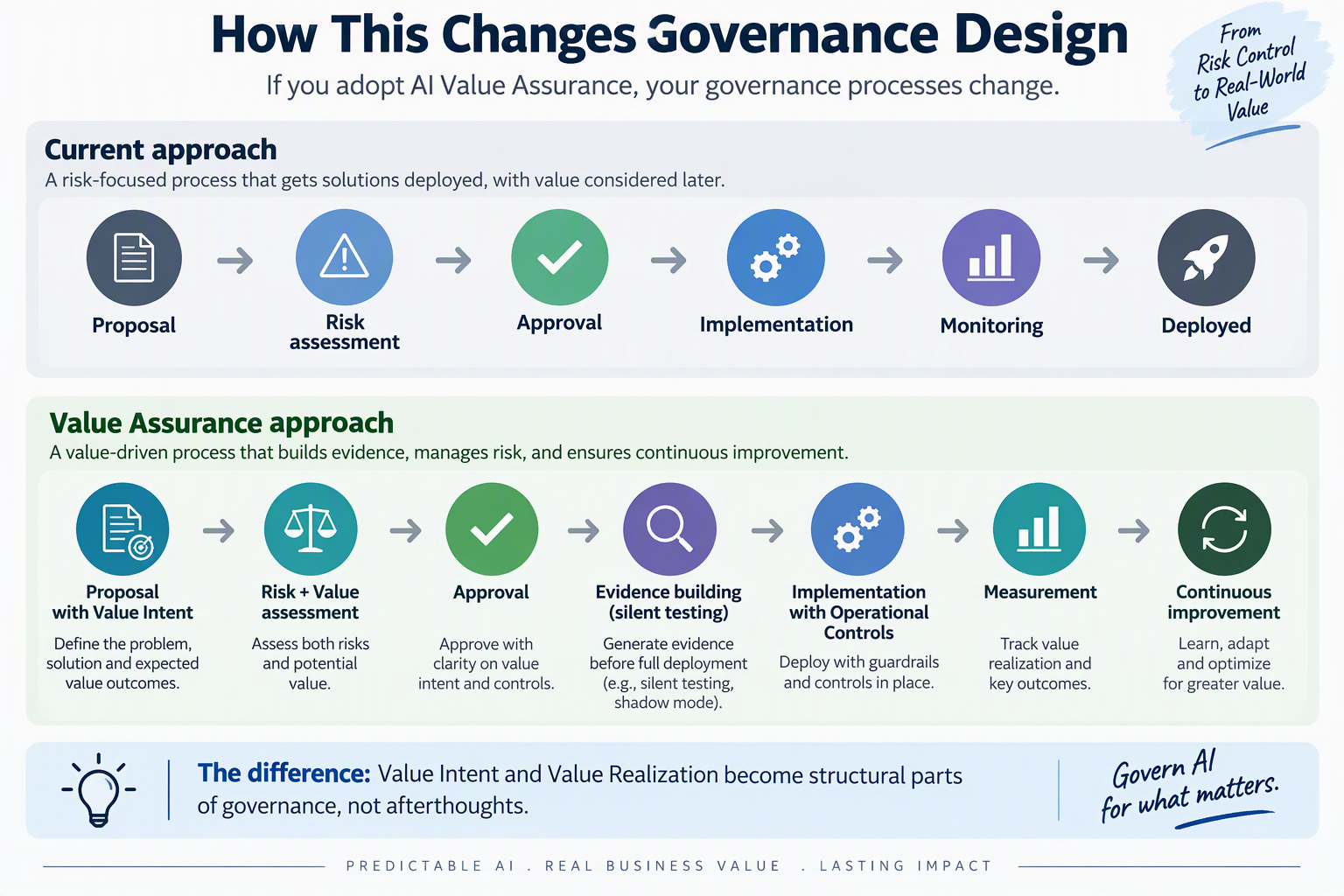
The difference: Value Intent and Value Realization become structural parts of governance, not afterthoughts.
The Strategic Implication
Here's what matters for your organization:
Enterprises that can prove AI value at scale will:
- Get more investment for AI
- Scale faster
- Attract talent
- Compete more effectively
- Have strategic leverage with customers
Enterprises that can't prove value will:
- Get scrutinized by CFOs
- Scale slower
- Struggle with ROI conversations
- Lose competitive ground
The difference between these two futures is AI Value Assurance.
Key Takeaways
- Governance isn't enough — It answers "Can we trust it?" but not "Is it creating value?"
- Value Intent is foundational — If you can't articulate the business outcome, the system shouldn't be approved.
- Evidence Before Autonomy is non-negotiable — Testing and silent mode prove the system can deliver before it's autonomous.
- Operational Assurance keeps it working — Controls and monitoring ensure predictability at scale.
- Value Realization proves the investment — Measurement shows whether the board's question gets answered: "Yes, it's creating value."
- These four levels must be connected — They're not sequential steps. They're an integrated system.
- At scale, you need a control framework — Managing 100 AI systems requires portfolio governance. Value Assurance provides it.
The next phase of enterprise AI governance isn't more risk management. It's proving value while managing risk.
That's AI Value Assurance.
Research Foundation
Governance Maturity & Value Measurement
Organizations have spent 2+ years building AI governance frameworks aligned with EU AI Act, NIST AI Risk Management Framework, and ISO/IEC 42001. This focus on risk governance is necessary but incomplete. Research on AI value realization (McKinsey, "The state of AI adoption," 2023) shows that 60% of organizations deploying AI struggle to measure ROI—not because the technology doesn't work, but because they haven't established value measurement frameworks.
Portfolio Governance at Scale
Enterprise architecture research and control frameworks (TOGAF, enterprise risk management standards) establish that managing multiple systems at scale requires integrated governance models, not system-by-system approaches. AI governance is beginning to adopt this principle, but most enterprises haven't operationalized portfolio-level value measurement.
Value Realization in Enterprise Transformations
Research on business value from enterprise transformations (ERP, cloud migration, etc.) demonstrates that value capture requires:
- Clear baseline and target definition
- Evidence before full deployment
- Operational controls maintaining performance
- Continuous measurement and adjustment
AI Value Assurance applies this proven pattern to AI systems.
Further Reading
Governance & Risk:
- EU AI Act (2024)
- NIST AI Risk Management Framework (2023)
- ISO/IEC 42001: AI Management Systems
Value Measurement:
- McKinsey: "The state of AI in 2023" and "Measuring AI's Impact" reports
- Gartner: AI Value Realization reports
- Harvard Business Review: "The Business Value of AI"
Enterprise Transformation & Scale:
- TOGAF 9 (Enterprise Architecture Framework)
- Enterprise Risk Management (COSO Framework)
- Business Value from IT Transformation studies
AI Use / Disclosure: This work represents my own ideas, objectives, expertise, and professional judgment. The underlying ideas, analysis, and final conclusions were developed and validated by me. Generative AI tools were solely used as an editorial aid to to assist with language refinement, formatting, style, structural improvements and image generation.