

Email remains a high-volume, high-friction enterprise channel—but not all email problems are the same.
In Pega, email automation can be delivered on Platform or Customer Service. Both use Pega Email Bot™ and support the Agentic Email Channel; the difference is the experience layer and the use case.
Incoming Email can be a simple trigger for a business process—or it can be the primary way customers engage with a service organization. Both approaches rely on the same underlying intelligence. The difference lies in the experience built around it and on primary the business goal.
This article explains the business context, the shared email foundation and a practical Positioning Shortcut you can apply to your scenario.
To clarify better why that distinction matters, let’s start with a scenario that will feel familiar to many practitioners.
Same Email. Same Intelligence. Different Experiences
Imagine an insurance provider receiving thousands of inbound emails every day.
In one part of the organization, those emails are largely operational. Customers submit documents, request policy changes, or send information needed to move a case forward. The email itself is rarely the focus. Once the message is understood and the right data is extracted, the work continues through validation, approvals, and downstream updates. Automation does most of the heavy lifting, and people step in only when exceptions occur.
In another part of the same company, email looks very different. Customers write with follow-up questions, complaints, or requests that require a thoughtful response. Agents manage queues, juggle priorities, review suggested replies, and pick up conversations that may span multiple messages. Tone matters. Context matters. The customer’s history across other channels matters.
It’s the same channel. But it’s not the same problem.
A Simpler Way to Decide
When teams ask me how to choose between Pega Platform and Pega Customer Service for email, I try to come back with three practical questions.
The first is who is really handling the email. If People involved are back‑office operators or process participants who only touch an email when something goes wrong, that usually points toward a process‑centric approach. Email is just one input into a broader workflow. If frontline service representatives spend most of their day living in an email queue—reading, responding, prioritizing, and resuming conversations—then email isn’t just a trigger. It’s the primary work surface.
The second question is what role email plays in the overall experience. In some scenarios, email starts a case and quickly fades into the background as automation takes over. In others, email is the experience. Customers expect timely, well‑phrased responses and continuity across interactions, and agents need full context to deliver that experience consistently.
The third question is where the operation is headed. Many teams start with email but don’t stop there. If the roadmap includes chat, voice, or a more unified service model, it’s worth thinking about how email fits into that broader picture. Treating email as part of an omnichannel service operation is very different from embedding it into a single, self‑contained process.
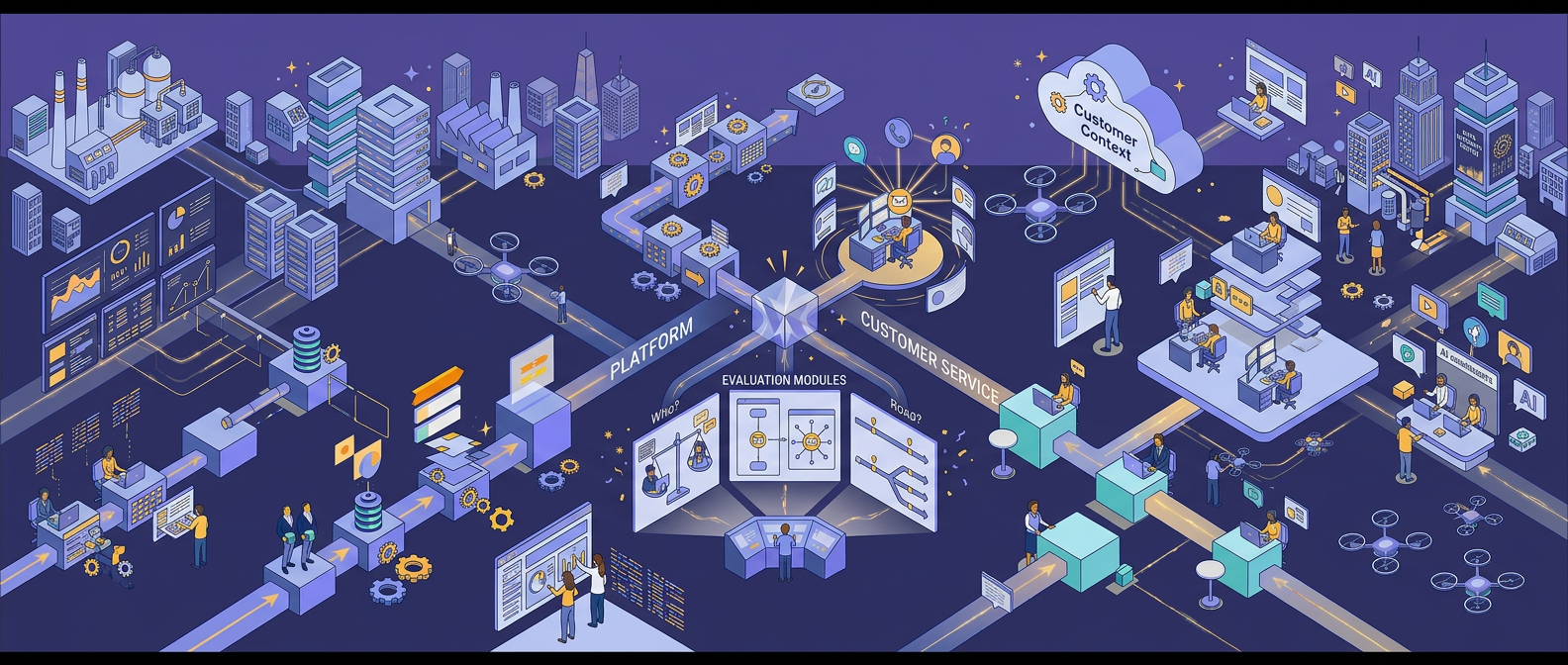
None of these questions are about which product is “better.” The difference is about context. Is email embedded within a workflow—or is it central to how customers engage with your service organization?
That distinction usually leads to the right answer.
Shared email foundation and specific capabilities
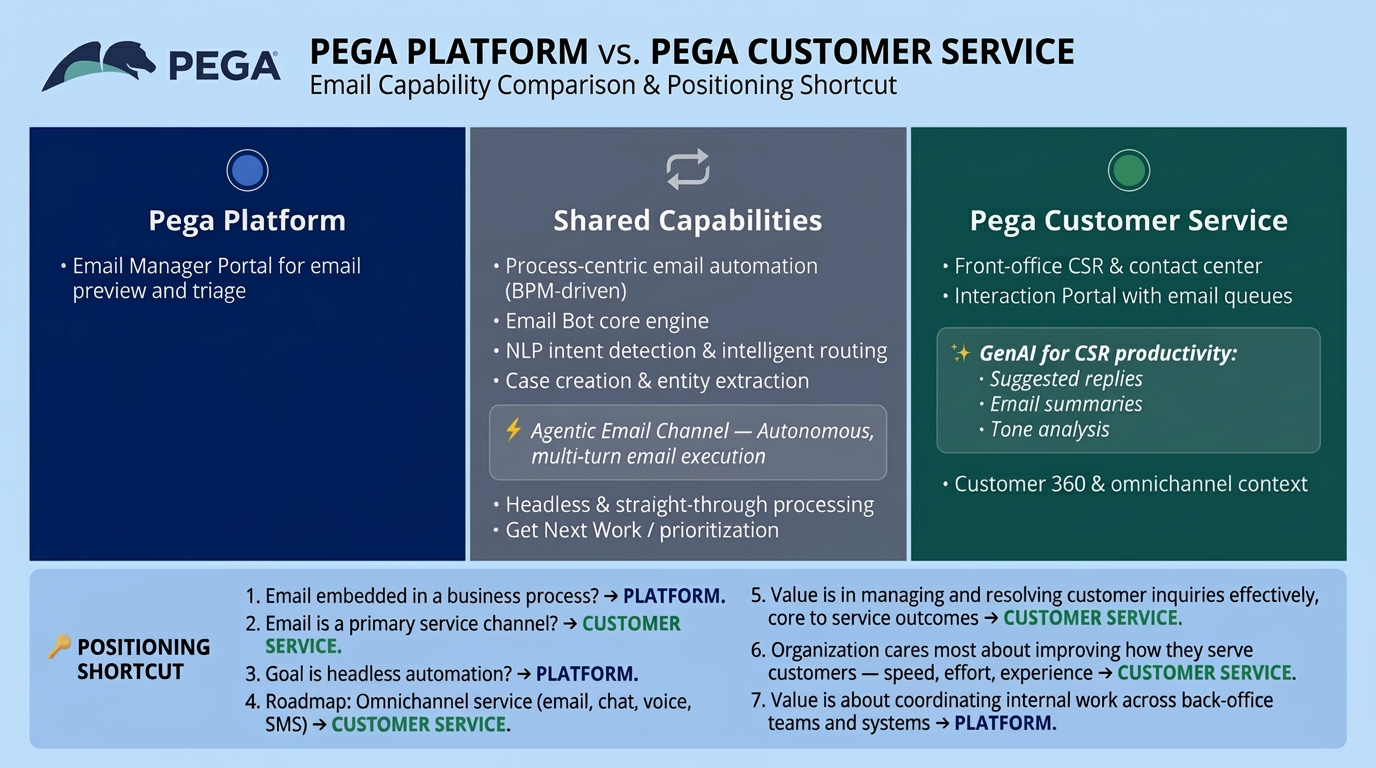
Both Pega Platform and Customer Service are powered by Pega Email Bot™, the core engine for intelligent email management. This means a significant set of capabilities is available regardless of which product is chosen:
Conclusion
Pega’s approach to email spans two purpose designed products built on a shared foundation. Pega Platform excels when email is part of a broader business process—flexible, extensible, and focused on orchestration and automation. Pega Customer Service is designed for service operations, where agents need prioritization, customer context, and AI assisted productivity to deliver consistent, high quality experiences at scale and focus on omnichannel customer experience.
The right choice is never about which product is "better." It is about fit with the context, personas and roadmap.
Recommended resources:
- Introduction to Pega Email Bot
- Email in Pega Customer Service
- Email Bots for Customer Service | Pega Academy
Don't Forget
JOIN THE CONVERSATION on the AI Expert Circle
