

Receive & Route: From Intake Automation to Predictable Enterprise AI
Enterprise AI becomes valuable when it can turn ambiguous demand into governed work. That is the real purpose of the Receive & Route pattern: to create a predictable front door for the enterprise, where unstructured signals are transformed into trusted cases, classified with the right level of intelligence, and routed into execution without bypassing control.
The strategic question is not whether GenAI should be used for routing. The better question is how rules, NLP/ML, and GenAI-based interpretation should work together across the lifecycle of an operating model. Receive & Route is therefore not only an automation pattern. It is a reference architecture for classification orchestration.
The operating problem: work rarely arrives ready
Inbound work arrives through emails, portal forms, documents, chats, service requests, voice transcripts, images, and system events. It may include
- missing information,
- multiple requests in one message,
- unclear intent,
- inconsistent wording,
- contradictory evidence, or
- attachments that contain the real business context.
Before this work can be routed, resolved, or automated, the enterprise must first understand what the work is.
This is why Receive & Route should be designed as an explicit operating capability.
Receiving establishes the trust boundary: what arrived, from which channel, for which customer, with which evidence, and with what confidence.
Routing determines what should happen next: assign, prioritize, request clarification, route to a queue, trigger a review, or continue toward resolution.
Generic reference architecture for Receive & Route
A generic Receive & Route architecture follows a simple but powerful sequence: inbound signal, channel normalization, extraction, classification, confidence gating, routing decision, execution handoff, and feedback capture. The architecture is not defined by a single model. It is defined by the control points between interpretation and action.
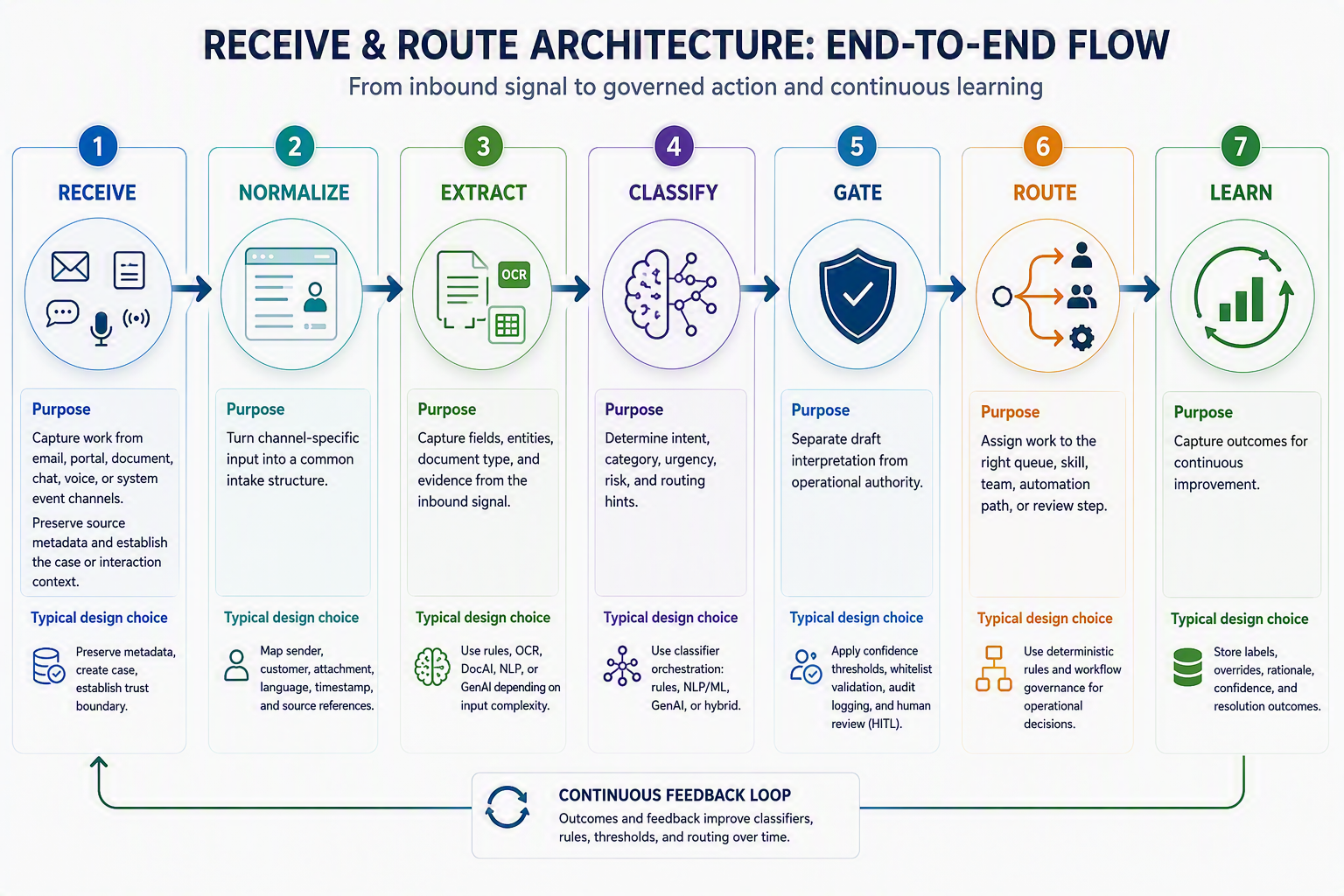
Overview of Receive & Route Steps
|
Architecture step |
Purpose |
Typical design choice |
|
1. Receive |
Capture work from email, portal, document, chat, voice, or system event channels. |
Preserve source metadata and establish the case or interaction context. |
|
2. Normalize |
Turn channel-specific input into a common intake structure. |
Map sender, customer, attachment, language, timestamp, and source references. |
|
3. Extract |
Capture fields, entities, document type, and evidence from the inbound signal. |
Use rules, OCR, DocAI, NLP, or GenAI depending on input complexity. |
|
4. Classify |
Determine intent, category, urgency, risk, and routing hints. |
Use classifier orchestration: rules, NLP/ML, GenAI, or hybrid. |
|
5. Gate |
Separate draft interpretation from operational authority. |
Apply confidence thresholds, whitelist validation, audit logging, and human review (HITL). |
|
6. Route |
Assign work to the right queue, skill, team, automation path, or review step. |
Use deterministic rules and workflow governance for operational decisions. |
|
7. Learn |
Capture outcomes for continuous improvement. |
Store labels, overrides, rationale, confidence, and resolution outcomes. |
The architectural choice: rules, NLP/ML, GenAI, or hybrid
The classifier is one of the most important design choices in Receive & Route.
It determines how the enterprise interprets inbound work before allowing the platform to act. Each classifier type has a different role, risk profile, and maturity path.
|
Classifier option |
Best fit |
Strengths |
Risks or limitations |
Recommended role |
|
1. Rules-based classification |
Known categories, explicit policies, compliance-sensitive routing, clear SLAs. |
Transparent, auditable, repeatable, easy to govern. |
Brittle when language varies or the taxonomy is immature. |
Use as the control plane for routing authority. |
|
2. NLP / ML-based classification |
Stable taxonomies with enough labeled examples and recurring language patterns. |
Scalable, consistent, measurable, and efficient for high-volume classification. |
Requires labeled data, model monitoring, retraining, and drift management. |
Use for industrialized classification once confidence is proven. |
|
3. GenAI-based classification |
Ambiguous, unstructured, multilingual, low-data, or long-tail inbound work. |
Flexible, fast to bootstrap, strong semantic interpretation, useful before a mature dataset exists. |
Probabilistic, prompt-sensitive, and unsuitable as unconstrained operational authority. |
Use for interpretation, recommendation, labeling support, and exception handling. |
|
4. Hybrid orchestration |
Enterprise-scale Receive & Route where input variability, risk, and maturity differ by category. |
Balances flexibility, repeatability, control, and learning. |
Requires clear ownership of thresholds, routing authority, and feedback loops. |
Use as the target operating model for predictable enterprise AI. |
Agentic shapes for Receive & Route
Agentic shapes describe reusable ways to assemble AI capabilities, workflow controls, and governance boundaries. For Receive & Route, the most useful shapes are not defined by how autonomous the AI is, but by how much interpretation it performs before the platform routes work.
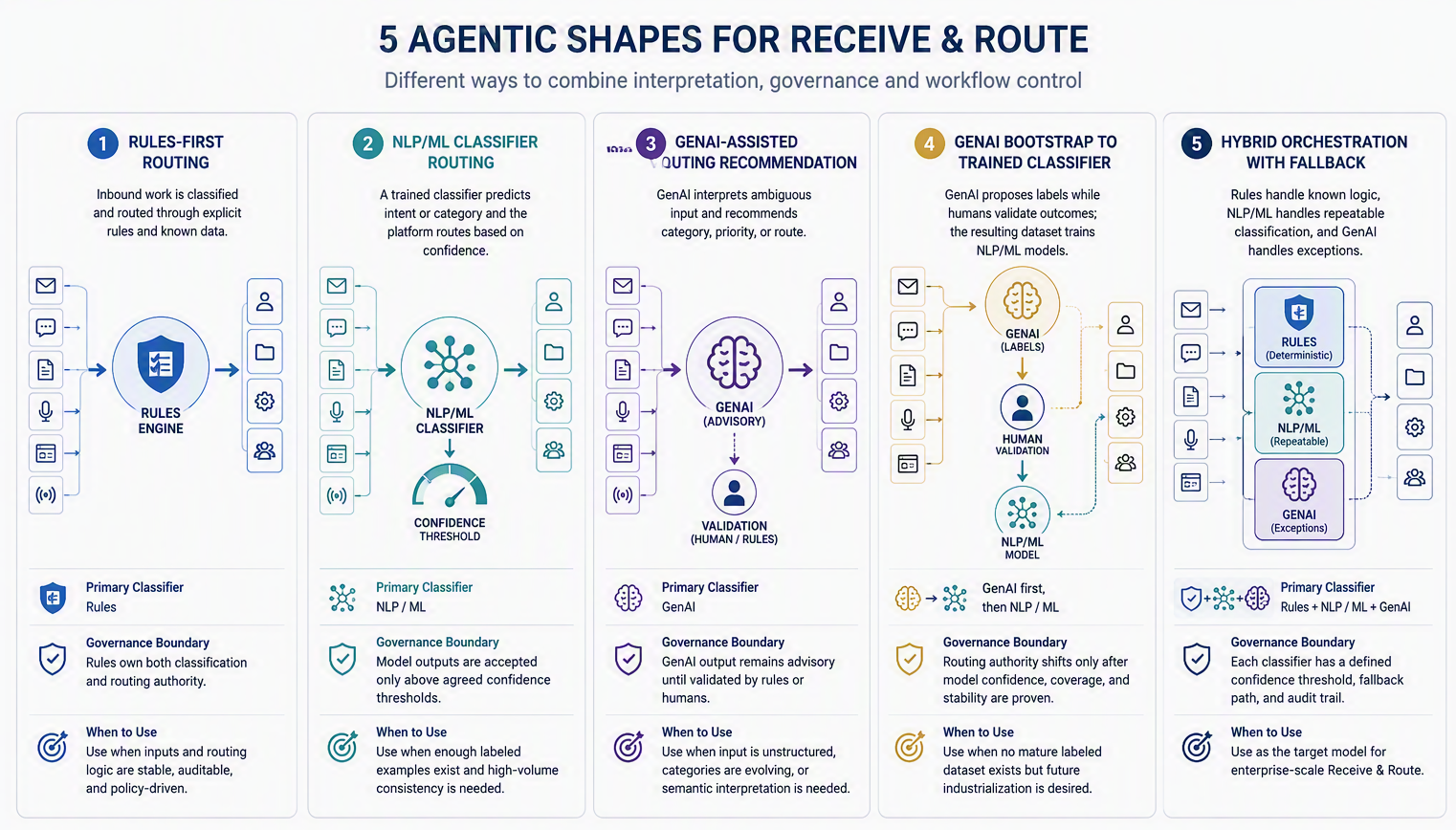
Overview of Agentic shapes for Receive & Route
|
Agentic shape for Receive & Route |
Description |
Primary classifier |
Governance boundary |
When to use |
|
Shape 1: Rules-first routing |
Inbound work is classified and routed through explicit rules and known data. |
Rules |
Rules own both classification and routing authority. |
Use when inputs and routing logic are stable, auditable, and policy-driven. |
|
Shape 2: NLP/ML classifier routing |
A trained classifier predicts intent or category and the platform routes based on confidence. |
NLP / ML |
Model outputs are accepted only above agreed confidence thresholds. |
Use when enough labeled examples exist and high-volume consistency is needed. |
|
Shape 3: GenAI-assisted routing recommendation |
GenAI interprets ambiguous input and recommends category, priority, or route. |
GenAI |
GenAI output remains advisory until validated by rules or humans. |
Use when input is unstructured, categories are evolving, or semantic interpretation is needed. |
|
Shape 4: GenAI bootstrap to trained classifier |
GenAI proposes labels while humans validate outcomes; the resulting dataset trains NLP/ML models. |
GenAI first, then NLP / ML |
Routing authority shifts only after model confidence, coverage, and stability are proven. |
Use when no mature labeled dataset exists but future industrialization is desired. |
|
Shape 5: Hybrid orchestration with fallback |
Rules handle known logic, NLP/ML handles repeatable classification, and GenAI handles exceptions. |
Rules + NLP / ML + GenAI |
Each classifier has a defined confidence threshold, fallback path, and audit trail. |
Use as the target model for enterprise-scale Receive & Route. |
The maturity path: GenAI first, ML/NLP when accuracy/confidence is proven
One of the strongest Receive & Route strategies is to use GenAI not as the permanent routing brain, but as the bootstrap mechanism for learning. In early phases, the organization often lacks labeled examples, stable taxonomies, or agreement on how requests should be classified. GenAI can propose intent, category, priority, rationale, and missing information indicators while humans confirm or override the result.
Every reviewed interaction should then become training evidence.
The system should capture the original request, extracted fields, proposed label, confidence score, rationale, human override, accepted label, final route, and outcome. Once the dataset reaches sufficient quality and coverage, an NLP/ML classifier can be trained and compared against both historical decisions and GenAI recommendations.
The switch should happen only when the trained classifier reaches agreed confidence thresholds for precision, recall, coverage, stability, and override rate.
At that point, ML/NLP can take over high-confidence repeatable classification, rules continue to govern routing authority, and GenAI moves into a fallback role for ambiguous, novel, multilingual, or long-tail cases.
Design principle: GenAI interprets, ML/NLP industrializes, rules govern
The most predictable Receive & Route architectures separate interpretation from authority.
GenAI is valuable where meaning is ambiguous and examples are scarce. NLP/ML becomes valuable when patterns repeat and labeled data exists. Rules remain essential where routing decisions affect ownership, SLA, priority, escalation, compliance, or automation eligibility.
This separation prevents a common enterprise AI failure mode: allowing probabilistic interpretation to silently become operational authority. A GenAI model may recommend a route, but the platform should decide whether that recommendation is accepted, rejected, reviewed, or used only as training evidence.
What good looks like
- Inbound demand is normalized across channels before routing decisions are made.
- Classifier outputs include confidence, rationale, source evidence, and fallback handling.
- GenAI outputs are marked as draft, advisory, or training evidence unless explicitly validated.
- Rules and workflow governance determine irreversible routing, escalation, prioritization, and automation actions.
- Human review is applied where confidence is low, consequence is high, or taxonomy fit is unclear.
- Every override and final outcome contributes to classifier improvement and future model training.
The implication
Receive & Route is more than a front-office automation pattern. It is the operating model for how enterprise AI enters the business safely. Leaders should not frame the decision as GenAI versus ML versus rules. The more mature framing is classifier orchestration: using GenAI to discover and interpret, ML/NLP to scale repeatability, and rules to govern action.
Predictable enterprise AI depends on this discipline. The organizations that scale agentic systems successfully will not be the ones that make every classifier generative. They will be the ones that design the front door well, measure how classification matures, and deliberately shift authority only when the evidence supports it.
AI Use / Disclosure:
This work represents my own ideas, objectives, expertise, and professional judgment. The underlying ideas, analysis, and final conclusions were developed and validated by me. Generative AI tools were solely used as an editorial aid to to assist with image generation, language refinement, formatting, style and structural improvements.