

Many practitioners spend years working on Customer Decision Hub (CDH) implementations. They have deep technical expertise, understand the platform inside out, and have successfully delivered complex solutions for their clients. Yet, when they pursue LDA Certification, some struggle to make the final leap. Interestingly, the challenge is often not technical capability.
Come as you are, bring your curiosity, and get ready to forge connections that go beyond the screen.
One of the biggest lessons I have learned through the LDA Certification journey is that the true value of an implementation does not come solely from how it was built. It comes from understanding why it was built and how it directly impacts the business. As practitioners, we naturally focus on architectures, integrations, strategies, AI models, and implementation details. While these are important, business leaders rarely judge success based on technical complexity. When you are presenting to a client executive, whether it is a CMO, SVP, or Head of Customer Experience, they are not looking for a detailed explanation of the implementation. Instead, they want to understand the business value.
They want answers to questions such as:
• How did this solution improve customer engagement?
• What business problem did it solve?
• How did it contribute to revenue growth, retention, or operational efficiency?
• What measurable outcomes were achieved?
This is where the role of a Lead Decisioning Architect becomes different from that of a technical practitioner. An LDA must be able to bridge the gap between technology and business. It is not enough to explain how CDH was integrated with existing systems. The real story begins when you explain how that integration enabled better customer decisions, improved business performance, and delivered measurable ROI.
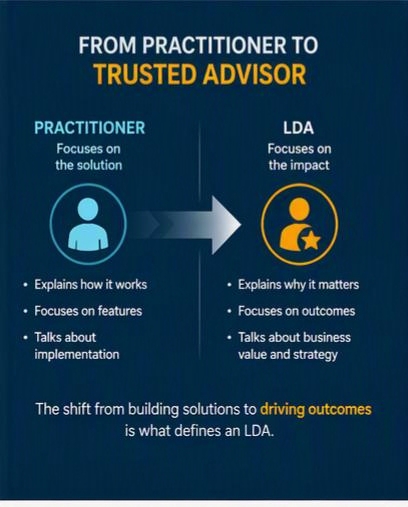
The most successful LDAs understand that every technical decision should connect back to a business objective. They can clearly articulate not only the solution design, but also the business impact that the design was intended to achieve. This ability also sits at the heart of consultative thinking. A practitioner can explain how a solution was implemented. A Lead Decisioning Architect can explain why that solution matters to the client. They connect technology to strategy, implementation to outcomes, and technical capabilities to business value. This is what helps build credibility, confidence, and trust with senior stakeholders. In many ways, this is what transforms a practitioner into a trusted advisor.
The same principle applies during the LDA Certification process. Candidates sometimes invest significant effort in demonstrating technical depth but spend less time showcasing the business value of their implementation. The panel is not only evaluating your technical expertise; they are assessing how effectively you can communicate business outcomes, influence stakeholders, and demonstrate consultative leadership.
One piece of advice we often share with aspiring candidates is simple: Treat the LDA Certification panel as your client.
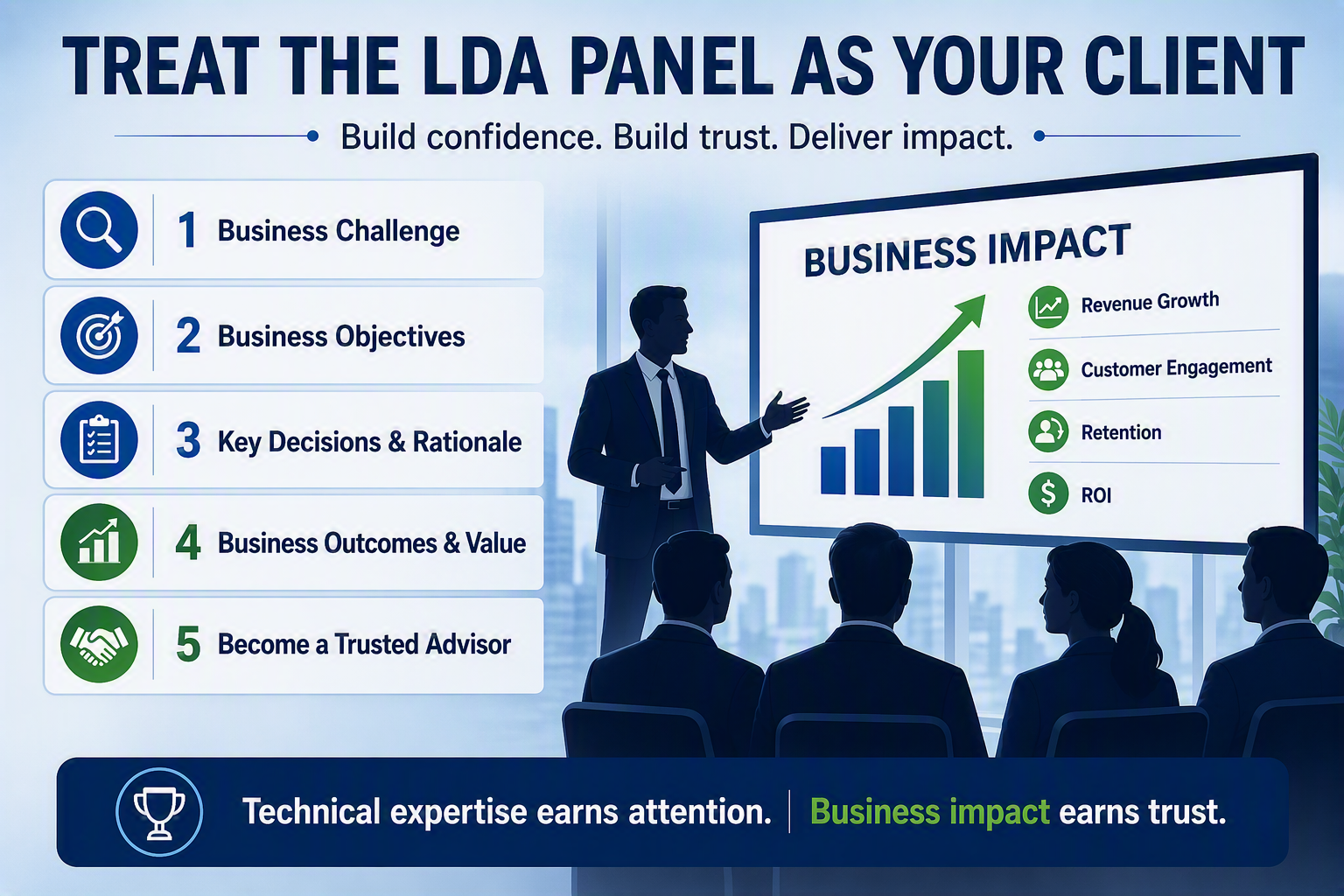
Approach your presentation as if you are speaking to executive stakeholders. Help them understand the business challenge, the objectives, the decisions that were made, and the value that was realized. Focus less on what was configured and more on why it mattered. When you do this, you demonstrate something far more important than technical competence. You demonstrate the ability to lead conversations, build trust, and position yourself as a strategic advisor.
Ultimately, technical expertise may help you implement a solution, but business understanding is what creates impact. And that is the true value of a Lead Decisioning Architect.
A great example: "Two candidates may present the same CDH capability. One explains more about how it was configured, while the other explains how it increased customer engagement and supported a strategic business objective. The difference isn't technical knowledge—it's business storytelling and consultative leadership."
Related Resources
- LDA Certification Webpage
- LDA Certification: All that you wanted to know about it and how to ace it!!
- Mastering the Path to Pega Lead Decisioning Architect Certification: Insights and Best Practices.
- LDA Certification: How did I prepare for the certification and how did it supercharge my career!
Don't Forget
- Continue the conversation on the Pega Community Forums.
