
Before You Deploy AI: The Predictability Checklist You NeedYour team is planning your first production AI deployment. The build is done; the AI models work well and then before signing off, the AI Board asks:
That question separates teams that deploy and scale confidently from teams that discover surprises later on. This article is for teams still in concept, planning or pilot phase. If you're deploying into production in the next months, read this. Why Predictability MattersRegulatory change is forcing the issue. The EU AI Act (2024) and NIST AI Risk Management Framework require post-deployment monitoring and operational oversight. But monitoring is reactive—you see problems after they happen.
Organizations that build predictability from day one have systems that behave consistently, reliably, and auditably. Organizations that add it later struggle to explain deviations. The good news: designing predictability into your system from the start costs less than retrofitting controls. The choices you make while planning directly determine whether your AI system will behave predictably once it's live. This article walks you through four predictability layers to think about now—before you deploy.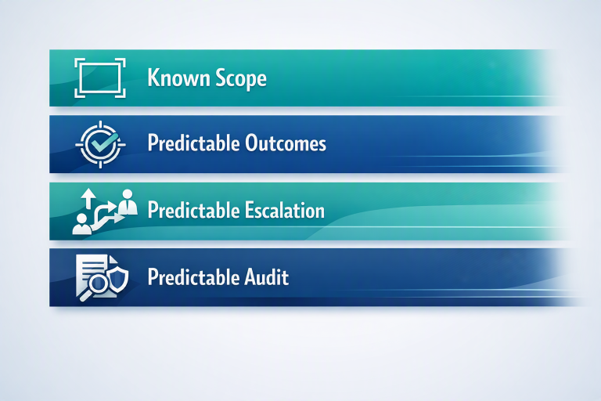
Layer 1: Known Scope — What Will This System Do (and Not Do)?Predictability starts with clarity. You define exactly what your AI system will and won't do—its scope, its boundaries, its intended use. Questions to ask:
If you're deploying a customer service AI, you know exactly which customer issues it can resolve (billing, account status, basic troubleshooting) and which it must escalate (complaints, disputes, sensitive information requests). You can predict, with high confidence, which requests go to the AI and which go to humans in the loop. In Pega: Pega Infinity 26 embeds governance into workflow design. Your scope rules are enforced at design-time, not runtime. The system doesn't let an AI agent drift beyond its intended boundaries because those boundaries are built into the CaseTypes/workflows itself.
You don't hope the AI stays in scope; you've designed it to be incapable of going out of scope. For detailed guidance, how to add agents to the CaseType explore Adding an Agent to a Workflow in Pega's documentation. ⚠️ For POC's & pilots: Document your scope clearly. What will this system handle? What won't it? Can you predict with 95% confidence which requests stay within scope? Layer 2: Predictable Outcomes — Can You Guarantee Consistent Behavior?Once a request is within scope, will your system behave predictably? Questions to ask:
Example: For a loan approval UseCase, predictable AI outcomes mean:
You can predict how the system will respond to 50 different loan profiles before you deploy. In Pega: Pega Predictable AI architecture maximizes control at design-time to ensure runtime operates predictably. Every rule, threshold, and decision path is defined before deployment. The system doesn't learn unpredictably in production; it executes exactly what you designed. Learn more about implementing Model Governance module, which covers transparency thresholds and responsible AI deployment practices. ⚠️ For POC's & pilots: Test your system against best possibly 100+ scenarios. Can you predict how it handles each one? If you can predict behavior consistently during pilots, you can predict it in production. Layer 3: Predictable Human Involvement/Escalation — Who Decides What, When?Predictability includes clear, predictable decision paths. When an AI system encounters something it can't handle, everyone knows what happens next. Questions to ask:
Example escalation rules (predictable):
Everyone knows the path. The process is predictable. There are no surprises at 2 AM. In Pega: Governance rules and escalation paths are built into CaseTypes/workflows. You don't improvise decisions in crisis; you execute pre-designed escalation logic. The outcome is predictable because the path is defined. For deeper understanding of AI agent design with built-in governance, explore The Agentic AI Design Approach on Pega Academy, which covers the four key principles of effective AI agents. Layer 4: Predictable Audit — Can You Prove Behavior Was Predictable?AI Boards & Regulators care about predictability too. They want evidence that your AI system behaved as designed. Questions to ask:
In Pega: Pega achieved ISO/IEC 42001:2023 certification for comprehensive AI governance. Audit logs prove predictability. Every decision is tied to a policy rule, every escalation is documented, every override is recorded. You can prove to regulators that your system behaved exactly as intended. For technical details on governance capabilities, see Pega's AI Overview and explore Prediction Studio's governance features for model monitoring and transparency. The Predictability ChecklistScope: Define what the system handles and what it doesn't. Can you predict which requests stay in scope? Can you predict escalations? Outcomes: Define 3–5 metrics for "correct behavior." Can you predict system behavior across 50+ test scenarios? What accuracy/consistency is required? Escalation: Define escalation triggers and decision owners. Can you predict the path for 10 different scenarios? Who decides what, when? Audit: Can you replay decisions and prove they followed expected rules? Are logs auditable? Can you link decisions to policies? The BenefitsTeams that design predictability into their AI systems
|

Before You Deploy AI: The Predictability Checklist You Need
About the Author
As head of AI and Advanced Analytics Consulting at Pegasystems, Florian leads a dynamic consulting team in providing innovative AI and Advanced Analytics solutions in EMEA. His work helps organizations to harness data-driven insights to achieve their strategic objectives, automate business processes and to advance the autonomous enterprise concept, as well as delivering projects and solutions that leverage cutting-edge technologies including Generative AI, Process AI (Machine Learning) and Process Mining.