

Agentic AI Best Practices – Designing Humans in the Loop (HITL)
How to combine agentic reasoning, human oversight, and governed case management in enterprise workflows
Human-in-the-loop is one of the most important design decisions in agentic architectures. It defines where autonomous reasoning or processing should stop, where a person should intervene, and which part of the system should own the human work.
A strong design does not simply ask whether a human is involved. It asks:
-
what kind of human oversight is required,
-
why it is required, and
-
whether that intervention should happen inside the agentic interaction or through a governed Case assignment.
|
Key message Human-in-the-loop should be designed as a governed oversight model. The Agent should reason, recommend, detect exceptions, and prepare context. Deterministic rules should decide when automation is allowed. The Case should own formal human work, including assignment, SLA, auditability, approval, exception handling, and continuation. |
1. Core design principle
The preferred enterprise pattern is to keep the Agent focused on autonomous reasoning, decision preparation, and handoff. When the Agent detects that human intervention is required, it should create or update a Case with the necessary context, recommendation, rationale, confidence level, and supporting evidence. The Case should then own the human assignment, routing, SLA, auditability, approval, exception handling, and downstream continuation.
Human-in-the-loop also acts as a predictability control. Before deployment, teams should be able to predict which requests the agent will handle, which decisions it will never make, and which situations will be escalated to a human. This turns HITL from an operational afterthought into an explicit design mechanism for keeping AI behavior within intended limits.
|
Best practice The Agent detects the need for human intervention, prepares the work package, and hands off to a standard Case assignment for the human decision or action. The Agent should not become a long-running human workflow unless there is a clear reason to keep the human interaction inside the same conversational or guided experience. |
2. Why the Agent–Case boundary matters
An Agent is best suited for bounded, autonomous work where the system can reason, enrich, recommend, or act within clearly defined limits and boundaries. A Case is better suited for governed human work that requires accountability, routing, reassignment, queue management, auditability, service-level tracking, and continuation over time.
-
Use the agent for interpretation, classification, summarization, enrichment, recommendation, tool execution, confidence assessment, and detection of exception conditions.
-
Use the Case for human assignments, approvals, exception handling, SLA tracking, auditability, routing, reassignment, and long-running orchestration.
-
Use deterministic rules to govern final routing, acceptance, escalation, and straight-through processing eligibility.
The Case Type should be treated as the operational harness around the agent. It defines the business context, allowed scope, escalation routes, human decision points, audit expectations, and continuation logic. This harness is what makes agent behavior predictable in production: the agent can reason within boundaries, while the Case controls what happens when those boundaries are reached.
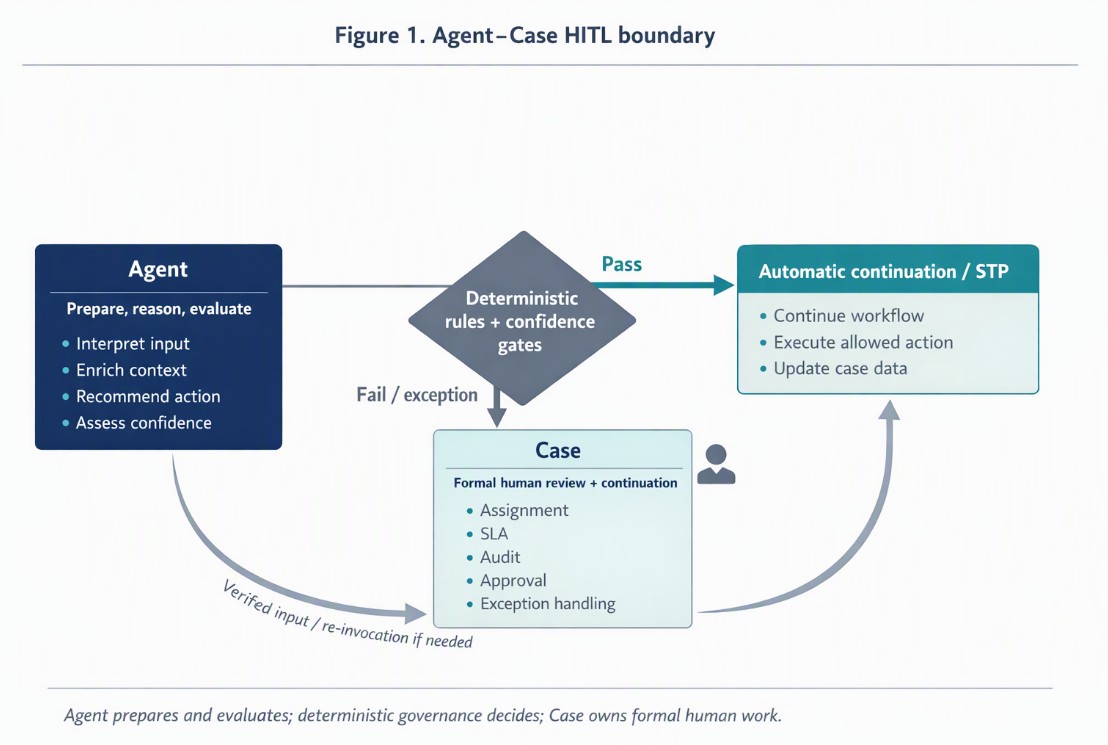
The boundary can be visualized as a simple decision gate between Agent execution and governed Case work.
Figure 1. Agent–Case HITL boundary. The Agent prepares and evaluates the work; deterministic rules and confidence gates determine whether work continues automatically or is handed off to the Case for formal human review and continuation.
3. Recommended architecture pattern
The cleanest architecture separates autonomous reasoning from formal human work.
The Agent should run autonomously until it reaches a guardrail, uncertainty condition, low-confidence signal, contradiction, policy exception, or approval requirement. At that point, it should create or update a Case, pass the prepared context into it, and either resolve or return a clear handoff status.
Autonomous path
-
The Agent interprets the input and prepares a recommendation.
-
Deterministic rules, confidence thresholds, and quality signals pass.
-
The work continues automatically or proceeds through straight-through processing.
HITL path
-
The Agent detects uncertainty, low confidence, contradiction, policy risk, or approval need.
-
The Agent creates or updates a Case assignment with recommendation, rationale, evidence, and confidence.
-
The Case owns routing, SLA, audit, approval, exception handling, and continuation.
-
If needed, the Case invokes the Agent again after the human decision is captured.
This separation keeps the autonomous unit small, distinct, reusable, and easier to test. It also avoids mixing Agent reasoning, human wait states, and operational workflow management in the same construct.
4. HITL support modes
Human-in-the-loop should be designed as a graduated oversight model rather than a single pattern. The right mode depends on risk, confidence, ambiguity, regulatory sensitivity, operational maturity, and the trustworthiness of the automation.
|
Mode |
Meaning |
When to use |
Implementation pattern |
|
Assisted |
The human validates every case while the Agent prepares draft fields, summaries, classifications, evidence, confidence, and rationale. |
High-risk, regulated, low-volume, early rollout, or when confidence scoring is not yet trusted. |
Create a Case assignment for every key decision. The Agent prepares the work package; the human owns the decision. |
|
Supervised |
The Agent recommends a decision, route, action, or downstream Case Type, and the human confirms, edits, or rejects the proposal. |
Medium-risk work where oversight is still required but the Agent can reduce effort. |
Create a Case assignment with the proposed decision, evidence, confidence level, and rationale. The Case captures approval or correction. |
|
Autonomous with exception review |
The Agent or workflow proceeds when rules and confidence thresholds pass; only exceptions go to humans. |
High-volume scenarios with reliable quality signals, clear thresholds, and deterministic governance. |
Proceed straight through only when rules pass, confidence is high, completeness is sufficient, and no ambiguity, contradiction, or sensitive-risk flag exists. Otherwise, create a Case assignment. |
The first table defines the modes. The decision matrix below helps choose the right mode for a specific scenario.
Decision matrix: choosing the right HITL mode
|
Decision factor |
Assisted |
Supervised |
Autonomous with exception review |
|
Risk level |
High |
Medium |
Low to controlled |
|
Human review frequency |
Every case or every key decision |
Every recommendation or selected decision |
Exceptions only |
|
Confidence maturity |
Low or unproven |
Medium |
High and calibrated |
|
Governance need |
Highest |
High |
Rule-driven |
|
Best operational fit |
Regulated review, early rollout, or low-volume work |
Human approval of Agent recommendations |
High-volume automation with exception handling |
|
Case assignment pattern |
Always |
Approval or validation step |
Only when thresholds, rules, or risk signals fail |
5. Confidence-based routing and STP eligibility
Confidence and quality signals should determine whether work proceeds automatically, receives light human verification, or requires full human review. The most useful signals include completeness, ambiguity, contradictions, extraction confidence, sensitive-topic flags, regulatory indicators, and automation rationale.
-
High confidence: proceed straight through if deterministic rules also pass.
-
Medium confidence: use supervised human confirmation or light verification.
-
Low confidence or conflicting signals: route to assisted human review.
-
Policy, regulatory, or sensitive-topic flags: route to human review unless explicitly governed otherwise.
6. When HITL can stay inside the agent interaction
Keeping the human interaction inside the Agent interaction is acceptable when the intervention is immediate, lightweight, and tightly coupled to the current reasoning step. Examples include a quick confirmation, choosing between two proposed categories, or approving a low-impact action in the same guided interaction.
However, once the human work requires SLA, queue ownership, reassignment, formal approval, exception handling, auditability, or delayed response, it should move into a Case assignment.
Inferred Agent outputs should be kept separate from verified human values. This supports audit, drift analysis, performance measurement, and future automation tuning.
Example: An intake Agent receives a customer message that appears to be a billing inquiry and proposes the category Billing question with 82% confidence. Because the user is still in the same guided interaction, the Agent may ask: “I think this is a billing question. Should I continue with that category?” If the user confirms immediately, the Agent can continue and store the result as a verified value while preserving the original inferred category, confidence score, and rationale for audit and performance measurement.
If the same customer message requires a supervisor approval, has a regulatory flag, needs reassignment to a specialist queue, or can only be reviewed later, the interaction should not remain inside the Agent flow. The Agent should create or update a Case assignment with the proposed category, rationale, confidence, source text, and recommended next action. The Case then owns the SLA, routing, approval, audit trail, and continuation after the human decision is captured.
|
Value type |
Example value |
Purpose |
|
Inferred Agent output |
Category = Billing question; confidence = 82%; rationale = invoice-related wording detected. |
Supports audit, drift analysis, model quality review, and automation tuning. |
|
Verified human value |
Category = Billing dispute, confirmed by the user or reviewer. |
Drives governed Case processing, routing, reporting, and downstream decisions. |
7. Predictability checklist before production
Before moving an agent-supported HITL design into production, teams should verify that the design is predictable enough to operate safely. The following questions should be answerable before deployment:
|
Predictability question |
Design artifact or control |
|
What work may the Agent handle autonomously? |
Agent scope and allowed actions |
|
What must the Agent never decide alone? |
Guardrails and escalation rules |
|
What triggers human review? |
Confidence, ambiguity, contradiction, policy, and risk thresholds |
|
What governs final acceptance or routing? |
Deterministic rules and Case logic |
|
What is handed to the human? |
Recommendation, rationale, evidence, confidence, and source references |
|
What happens after human input? |
Case continuation or Agent re-invocation |
|
How are values audited? |
Separate inferred, verified, and governed values |
|
How is drift monitored? |
Overrides, correction patterns, and quality metrics |
8. Common anti-patterns
A weak HITL design often fails because it gives the agent too much workflow responsibility or because it treats all human review as the same type of intervention. The following anti-patterns should be avoided:
-
Turning the Agent into a long-running human workflow.
-
Mixing autonomous reasoning and human queue management in the same unit.
-
Letting inferred AI values drive final decisions without deterministic governance.
-
Routing every exception through the same review path regardless of risk or confidence.
-
Failing to capture confidence, rationale, evidence, and human corrections.
-
Not distinguishing assisted, supervised, and autonomous operating modes.
9. Practical decision rule
Use the following rule of thumb when deciding how to support human intervention:
|
Situation |
Recommended HITL mode |
Recommended pattern |
|
Quick user confirmation within the same interaction |
Lightweight supervised |
Keep inside the agentic interaction. |
|
Every case requires validation |
Assisted |
Create a Case assignment for every item. |
|
Human must approve the agent recommendation |
Supervised |
Create a Case assignment with recommendation, rationale, confidence, and evidence. |
|
Only exceptions require review |
Autonomous with exception review |
Proceed automatically unless thresholds, rules, or risk signals fail. |
|
SLA, audit, queue, reassignment, approval, or delayed response is needed |
Assisted or supervised |
Use a standard Case assignment. |
|
The agent can continue after human input |
Supervised continuation |
Let the Case capture the human decision and invoke the agent again if needed. |
|
The agent’s only job is triage or escalation |
Any mode |
Resolve the agentic flow after handoff. |
10. Final recommendation
The practical goal is not to maximize or minimize human involvement. The goal is to place human judgment exactly where it improves safety, accountability, and predictability.
The Agent should detect ambiguity, low confidence, contradictions, missing information, sensitive topics, policy exceptions, or approval requirements. It should then prepare the human work package and hand it off to the Case to be picked up by a human assignment.
The Case should own the human assignment, SLA, auditability, approval, exception handling, reassignment, and continuation. The Agent should remain responsible for reasoning, recommendation, evidence preparation, and handoff. Where the agent’s task is complete after escalation to the Human in the loop, it resolves after creating or updating the Case and starting a human assignment. Where the Agent needs to continue, the Case should capture verified human input and invoke an Agent again after the human assignment.
|
Key takeaway AI should propose and prepare; deterministic rules should govern; the Case should own formal human work. |