

As the landscape of customer service continues to evolve, a notable shift is underway: organizations are moving beyond isolated automation and embracing truly agentic customer service experiences. This transformation - already evident in many leading practices - marks the beginning of a new era in which intelligent, context-aware tools work together to deliver seamless, dynamic support. In this blog, we’ll explore what this means for the future of customer service, and how your team can take advantage of these emerging capabilities.
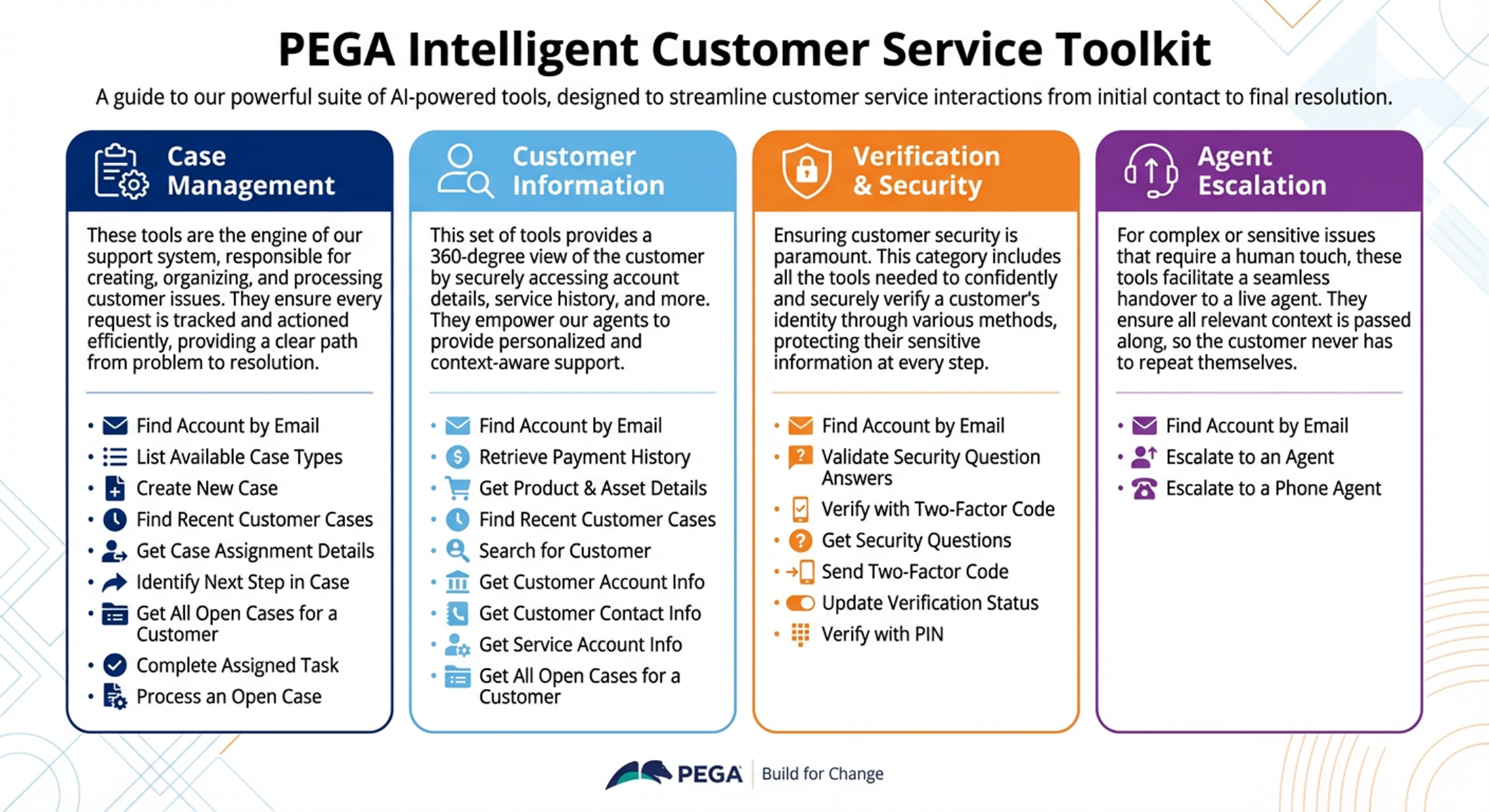
With the recent release of Pega Customer Service 25.1.2, a significant set of new Agentic Tools is now available out of the box. What’s notable isn’t just the volume of tools, but what they can enable together: teams can now assemble agentic experiences quickly, using production ready building blocks rather than designing everything from first principles.
This post isn’t a release announcement or a deep-dive technical walkthrough. It’s a discussion starter that is focused on how these tools really change how we think about solution design.
Here at Pega our point of view is simple: Agentic experiences only work at enterprise scale when autonomy is grounded in a core foundation of process, policy, and context.
Agentic tools, not just individual actions
Looking across the toolset in Pega Customer Service, a clear pattern emerges. These tools are not low-level APIs – they are context-aware, opinionated actions that are designed to work together.
Broadly speaking, they support the following recurring needs:
-
Establishing (and maintaining) customer and account context
-
Enforcing identity verification and client policies before action
-
Creating, resuming, and progressing service cases
-
Detecting ambiguity and escalating safely when needed
Individually, each tool does one thing really well. Collectively? They form the foundation for agentic flows where an experience can sense intent, gather context, act, and then recover when confidence drops.
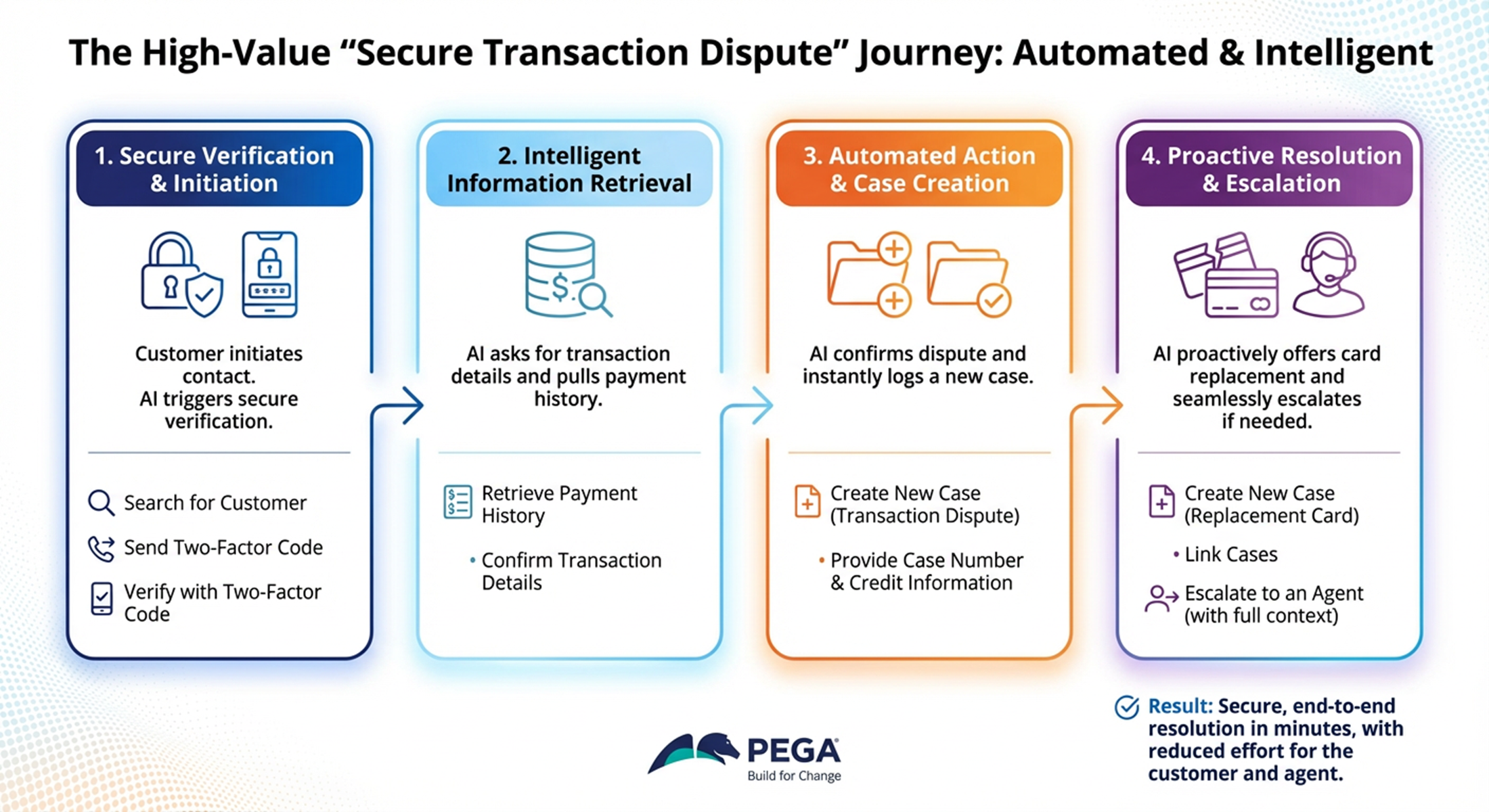
This is a really important shift. Our design question becomes less about “What can I automate?” and more about “What journeys can agents meaningfully participate in?” Here is an idea for taking transaction disputes into Agentic channels, massively accelerated by using the new OOTB tools.
Autonomy with guardrails built in
One thing that stands out across the Tools now available is just how explicitly guardrails are treated.
Before sensitive data is accessed or work is progressed, there are dedicated tools for customer identification, service account scoping, and multiple verification paths (PIN, OTP, security questions). Verification state is tracked explicitly, not implied.
When intent remains unclear or automation reaches its limits, escalation is not an exception path - instead it’s a first-class capability, including clear handoffs to human agents across digital and voice channels.
The result is autonomy that is policy-driven and deliberate, rather than uncontrolled. For many organizations, this is what makes agentic approaches viable beyond experimentation.
What you can build faster now
Rather than listing tools, it’s more useful to think in terms of scenarios that can now be composed quickly using what’s already provided:
-
A customer contacts support with incomplete information, and the system identifies them, narrows context, and either progresses the request or escalates appropriately.
-
An authenticated customer asks about open or recent cases, and only the correct, scoped results are returned.
-
An agent hands off to a human cleanly when confidence drops, preserving conversation and case context.
None of these rely on a single “smart” capability. They emerge from orchestrating the available tools into coherent agentic journeys.
Why this matters for design teams
This release starts to alter the starting point for architects and delivery teams.
Much of the hard work (verification, escalation, case progression, recovery) is already expressed as reusable tools. That shifts effort away from plumbing and toward experience design, intent modelling, and governance decisions.
It also surfaces important design questions:
-
“Where should autonomy begin and end?”
-
“Which guardrails are nonnegotiable in your industry?”
-
“How much ambiguity should an agent tolerate before escalating?”
These are not product questions, they’re design questions - and exactly the kind of questions worth exploring together.
Recommended resources:
Pega Customer Service Release Notes
Pega GenAI in Pega Customer Service | Pega Academy
JOIN THE CONVERSATION on the AI Expert Circle
