
Conversation

Pegasystems Inc.
NL
Last activity: 10 Dec 2025 4:13 EST
Accelerating Time to Value: Best Practices on Delivering in Challenging Timelines
Disclaimer: The content provided in this document is based on the author's personal observations and experiences from a real project. It does not represent the official views, guidance, or recommendations of Pega.
Accelerating Time to Value: Best Practices on Delivering in Challenging Timelines
Why:
Delivering exceptional user experiences in Pega applications at a rapid pace is a shared mission. Success depends not only on technology, but also on how teams are organized, requirements are captured, stakeholders are engaged, and iteration is executed with agility. This article highlights proven best practices drawn from real project experience to help our community drive business value and user satisfaction within challenging timelines.
These best practices are especially applicable to projects embracing the Low Code Enterprise Development (LCED) approach. In this paradigm, business solutions are delivered rapidly by leveraging modularity and reuse, empowering both IT and business stakeholders to collaborate effectively. By focusing on modular design and reusable features, teams can accelerate delivery, separate technical concerns, and ensure solutions remain adaptable and scalable to evolving business needs.
The following best practices explain the need and benefits of team organization, streamlined requirement capture, scoping for a minimum lovable product, continuous feedback loops, and ongoing alignment.
Best Practices:
1. Organize Teams for Success
Clear ownership and smart team allocation are foundational for scalable and maintainable enterprise Pega solutions. By having dedicated teams focused on delivering distinct functionalities, you can optimize resource allocation, minimize overlap and confusion among team members, and deliver multiple functionalities in parallel. For applications where reusable features and interfaces are in scope, it is best practice to have one fully dedicated team deliver the business application (front-end), and multiple dedicated technical teams, each responsible for one end-to-end modular application (an application that offers (complex) reusable features, business logics, and interfaces to the business applications). The number of technical teams should be based on module complexity and workload. Where modules are less complex and the workload is lighter, multiple modules can be assigned to one team.
Benefits:
- Distinguished delivery ownership for each workflow and module: Assigning clear responsibility eliminates ambiguity, accelerates decision-making, and reduces bottlenecks.
- Allocated teams by module complexity: By matching skills to challenges, high-complexity functionalities benefit from specialized expertise, while simpler functionalities can be handled by broader teams, optimizing resources and quality.
- Fostered collaboration between business and delivery teams: Involving business stakeholders early and often ensures requirements are accurate and solutions truly reflect business needs, minimizing costly rework.
2. Streamlined Requirement Capture
Kick off with an LCED design workshop focused on capturing business needs and goals, having constructive discussions around requirements and potential high-level solutions with both IT and business stakeholders, highlighting reusable features, and concluding the workshop with a high-level design in Blueprint or App Studio. This sets the stage for streamlined, rapid, and business-driven development.
Benefits:
- LCED design workshop: Bringing business and IT together at project start for a three-day workshop to define requirements and high-level solutions accelerates time to market, sets expectations among team members, and empowers business-driven development.
- High-level requirements: Focusing on high-level requirements reduces ambiguity and confusion, helping teams quickly grasp business needs.
- Defined reusable features: Promotes modularity and reuse, sets clear expectations for advanced developers, and enhances collaboration and scalability of the solution.
- Captured requirements directly in Blueprint/App Studio: Using Blueprint or App Studio as your single source of truth speeds delivery, reduces rework (time spent on creating flowcharts in Miro, Figma, Visio, etc.), and makes sharing requirements seamless across teams. Additionally, by working directly in Blueprint or App Studio, processes can be demoed frequently, increasing feedback capture, rapid iterations, and user confidence.
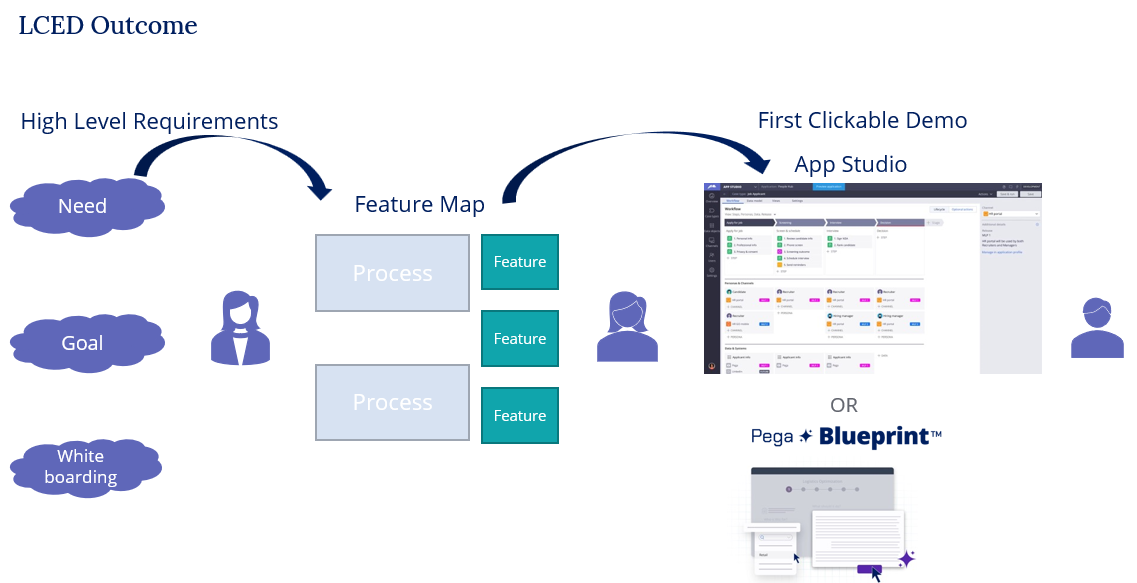
Figure 1: From business need to first clickable demo: LCED workshops streamline requirement capture and accelerate delivery by mapping high-level requirements to modular features in App Studio or Blueprint. (Courtesy of Marco Duizer).
3. Prototype Early & Define Scope
Early prototyping and scope clarity help teams experiment, validate, and deliver what matters most. As a best practice, build the prototype in Blueprint or App Studio (preferably in lab environment) to achieve a high-fidelity (detailed design). Once stakeholders agree on the detailed design, revisit the scope to tailor it for your Minimum Lovable Product (MLP).
Benefits:
- Building workflow prototypes: Using Blueprint or App Studio to reach an agreed-upon detailed design enables the team to try multiple alternatives to achieve an optimized final design, while continuously demoing outcomes and gathering stakeholder feedback. Additionally, prototypes built in lab environments and/or Blueprint can be imported into the actual development environment.
- Scoping for Minimum Lovable Product (MLP): Focusing on essential features for the first MLP helps optimize resources and deliver value quickly.
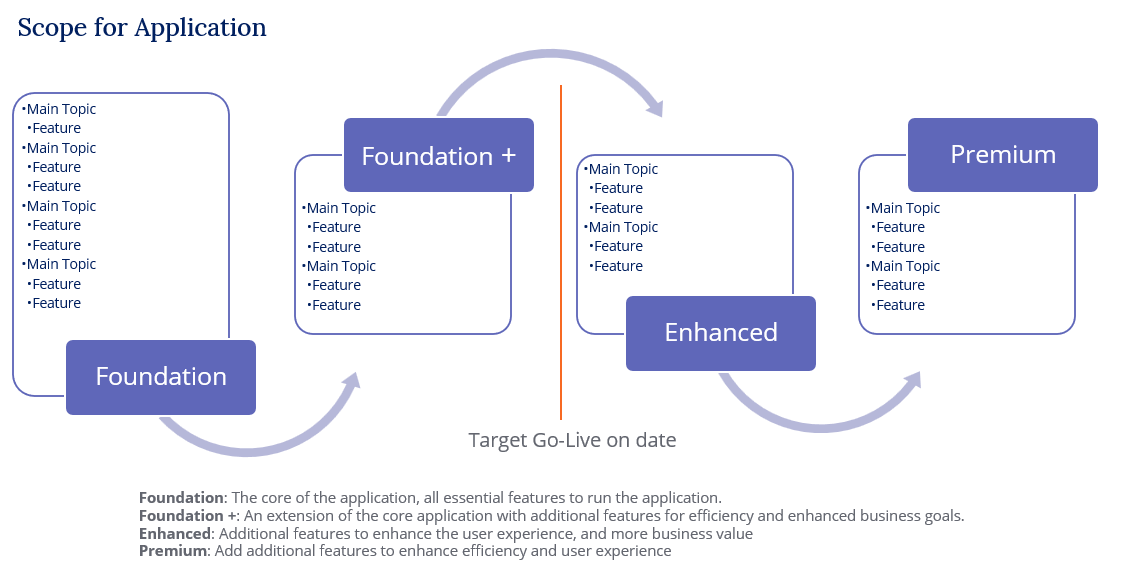
Figure 2: Scoping for Minimum Lovable Product (MLP): Focus on essential features for rapid value delivery, with a clear path from foundational to enhanced and premium application capabilities. (Courtesy of Marco Duizer).
4. Agile Delivery & Rapid Iteration
Agile practices empower teams to deliver quality solutions faster and adapt to change. Embracing model-driven development instead of document-driven development enables teams to collaboratively build workflows using App Studio capabilities. In this approach, Business Architects and SMEs focus on configuring out-of-the-box functionalities, while advanced developers support more complex features. As a best practice, define focused areas (such as Epics) and assign each area to a single team member, rather than creating multiple user stories and having several team members working on the same area.
Continuously show progress to stakeholders and iterate based on their feedback. To gather feedback effectively, define a Demo/UAT plan from the beginning. As a best practice, schedule biweekly demos with key decision makers, and conduct multiple UATs with end users.
Benefits:
- Defining epic-level focus areas: Enables parallel delivery and model-driven development, reducing code merges and accelerating time to market.
- Assigning each focus area to a single team member: Reduces ambiguity and multitasking, leading to better quality and fewer errors.
- Building workflows directly in App Studio: Reduces the complexities of rule creation in Dev Studio and saves time spent on external tools for building flowcharts. Additionally, feedback can be rapidly incorporated in App Studio and demoed in real time by Business Architects, eliminating the need to go through the traditional user story lifecycle. Furthermore, App Studio enables SMEs to co-configure workflows with Business Architects and System Architects, increasing collaboration and ownership.
- Demoing frequently: Capturing feedback early and iterating rapidly reduces the risk of failures, enhances process quality, and increases stakeholder confidence and trust.
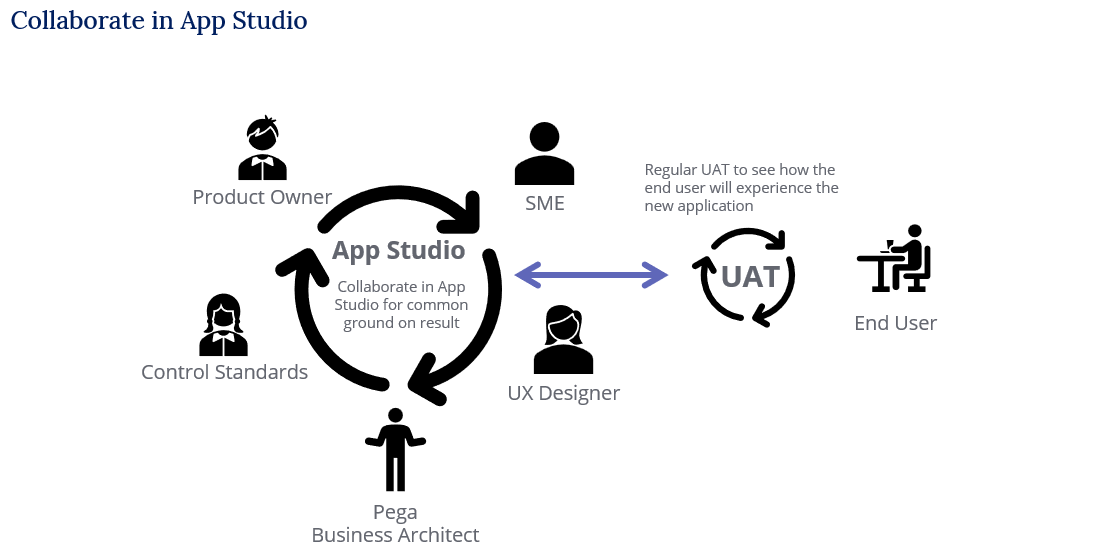
Figure 3: Agile collaboration in App Studio: Product Owners, SMEs, UX Designers, and Business Architects work together, enabling frequent demos and rapid feedback through regular UAT sessions. (Courtesy of Marco Duizer).
5. Continuous Alignment & Governance
Ongoing alignment and governance keep teams focused and solutions robust. Increasing focused working time for team members is essential for successful accelerated deliveries. As a best practice, instead of multiple less effective meetings (e.g., refinement or story sizing sessions), schedule a daily one-hour alignment session placeholder for project-wide work, in addition to a 15-minute progress update. This alignment session can be used on demand whenever different teams or team members need to align business requirements. This approach works well with focused area development practices.
Business logic and granular requirements are provided by SMEs. Instead of lengthy traditional requirement capturing sessions, a best practice is to assign full-time SMEs to the project, ensuring that delivery teams have immediate access to business needs and logic.
Benefits:
- Increased focused work time: Gives teams more time for development and innovation instead of participating in unnecessary meetings.
- Dedicated SMEs: Provides immediate access to granular requirements and fact-checking. Additionally, SMEs can serve as citizen developers configuring business processes alongside other team members.
- In-office collaboration: At least two days per week in-office work fosters cross-functional knowledge sharing and team trust.
- Continuous collaboration with module teams: Continuous collaboration between business and module teams ensures that alignment between business needs and modular features are maintained and that the modules are business driven.
6. Conclusion
Traditional delivery methods are more time consuming because they focus on lengthy requirement capturing sessions, extensive as-is process analysis, building detailed documentation, and siloed work using tools like Miro and Figma. To accelerate time to value, shift the focus to clear team ownership, modular architecture and reuse, and direct collaboration in Pega tools such as Blueprint and App Studio. Prioritize building business solutions over documents, work in focused areas rather than user stories, embrace continuous feedback and rapid iteration, and eliminate unnecessary distractions. This approach enables faster, scalable, and business-driven delivery.
7. References
• Low-Code Enterprise Development - Pega Docs
• Pega Blueprint in App Studio application development - Pega Docs
• Low-code defined - Pega Academy
• Low-code application development - Pega Academy
• Blueprint best practices for Case Lifecycle design - Pega Academy
• Application development in App Studio - Pega Academy